Readers researching ai face swap can use this review to see how Higgsfield AI and Kyncept handled the same Tokyo image test, including visible watermarks, output formats, credits, and the limits of the timing comparison.
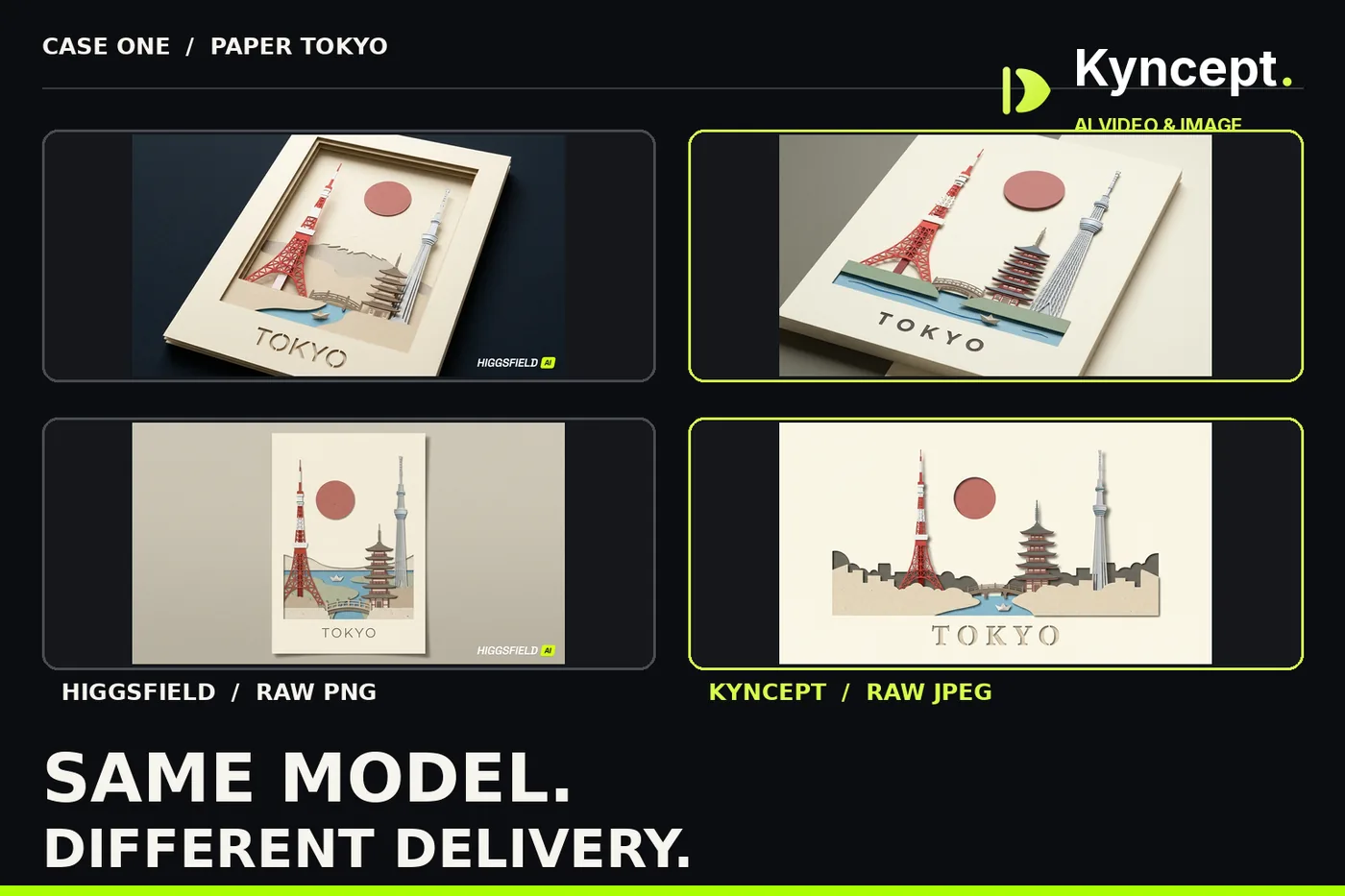
Four Tokyo paper-cut images from the same displayed model are a close call on visual content. The differences a reader can verify are the originals' watermark, file format, poster composition, credit debits and incomplete timing record.
Independent review: both products were run on my own accounts — a free tier and a paid plan — with no vendor-provided access.
My verdict in 60 seconds
Higgsfield and Kyncept each completed two Nano Banana Pro image jobs from the same adapted Tokyo prompt with 16:9 selected in the interface. All four files measure 1376×768 pixels. At this sample size, a reasonable subjective judgment is a content-quality tie, not a claim that the outputs are pixel-identical or that either service is generally better. Higgsfield's raw PNGs both carry a baked-in “HIGGSFIELD AI” mark at the lower right; the two inspected Kyncept JPEGs have no visible brand mark. Higgsfield took two of its own credits per image, Kyncept one of its own. The timing evidence is too incomplete to award either side a general speed victory.
- Shared test — two outputs per product, same text prompt and displayed Nano Banana Pro label.
- Canvas — all four 1376×768, despite a 16:9 UI selection; the file-pixel ratio is approximately 1.7917.
- Content — each set shows Tokyo Tower, Skytree, red sun, bridge, pagoda, small boat and “TOKYO,” with distinct layouts.
- Packaging — Higgsfield writes PNG RGBA with a visible baked brand mark; Kyncept writes JPEG RGB without a visible brand mark in the two originals inspected.
- Timing — one Higgsfield UI interval and one Kyncept UI interval are exact; the other two are missing or bounded rather than comparable point values.
Every original is linked from the Tokyo evidence report, not replaced by a polished mock-up.
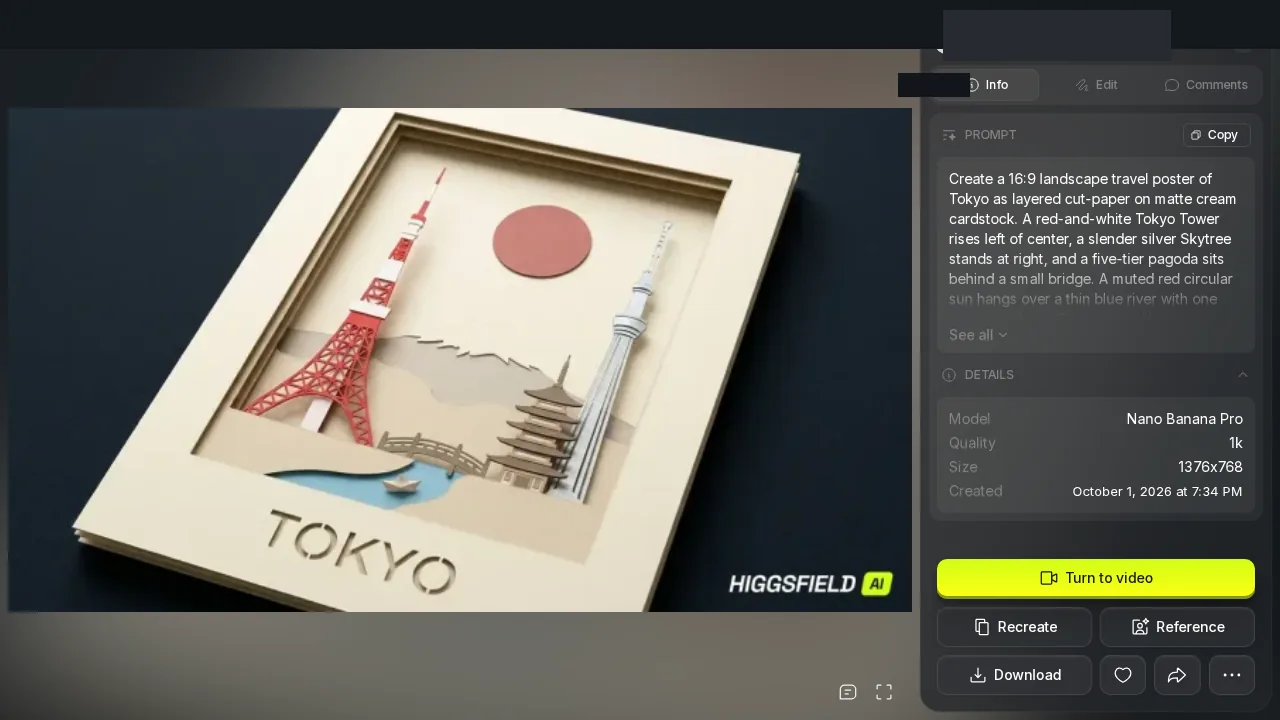
Higgsfield image 1 in its result preview; follow the report link for the untouched 1376×768 PNG and its brand mark.
What a four-image test cannot establish
This is a hands-on comparison of two third-party tools. Kyncept and Higgsfield are the two products in this trial. The original files, redacted workflow screenshots and raw numbers are available for inspection. This is two runs on each side for one prompt, not a blind panel, a multi-prompt study or a broad performance estimate for either service.
The paper-Tokyo idea was inspired by social-media examples, but the wording submitted here was an original adaptation, not a verbatim viral prompt. Both product interfaces received the same text. I compared what the UI and the downloadable files showed, without inferring an underlying provider or claiming a contractual right to watermark-free or commercial exports on untested subscription tiers.
The prompt was more specific than “make Tokyo art”
It requested a landscape travel poster on matte cream cardstock, Tokyo Tower left of center, a slender silver Skytree to the right and a five-tier pagoda behind a small bridge. The red circular sun, a thin blue river, one tiny boat, paper fibers, visibly layered cut edges and only “TOKYO” printed along the bottom gave the images concrete details to inspect. The UI selection was 16:9 in both products. That aligns the tested request, but it does not guarantee identical random seeds, rendering choices, file encoding or literal compliance with every adjective.
The four originals include the major landmarks and paper-layer theme. They differ most obviously in how they interpret poster: Higgsfield image 1 and Kyncept image 1 show a physical, tilted cardstock piece in the scene; Higgsfield image 2 puts a portrait-oriented poster object inside a landscape canvas; Kyncept image 2 presents a wider, flatter composition. Those observations say more than a declaration that all four are simply “the same image.”
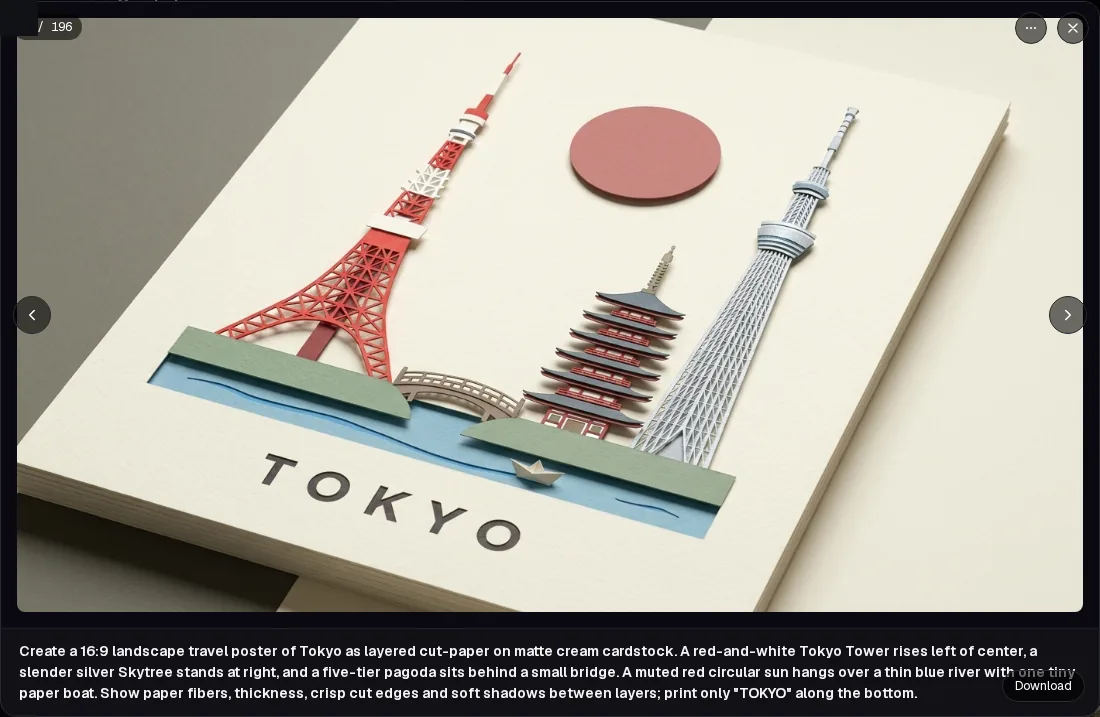
Kyncept image 1 also favors a tilted physical paper-piece interpretation, a useful comparison with Higgsfield image 1.
Pair one: two tilted paper objects, not a clear artistic winner
The first Higgsfield original contains a dimensional cream frame on a dark field. Tokyo Tower dominates the left, Skytree rises at right, and a small paper boat sits on the blue river below a muted red sun. The bottom border reads TOKYO. Its lower-right corner also reads HIGGSFIELD AI: that is not a label we added in a screenshot. The lettering is present in the downloaded PNG.
Kyncept's first original shows another angled layered card. Its landmarks, bridge and paper boat are recognizable, and “TOKYO” runs across the bottom. It has a different crop and spacing from the first Higgsfield image; neither is a reference copy of the other. Whether a client prefers the darker gallery-like scene or the lighter tabletop feel is a subjective decision. On this first pair, the defensible statement is that both make coherent paper-cut Tokyo imagery and one carries an additional brand mark in the raw file.
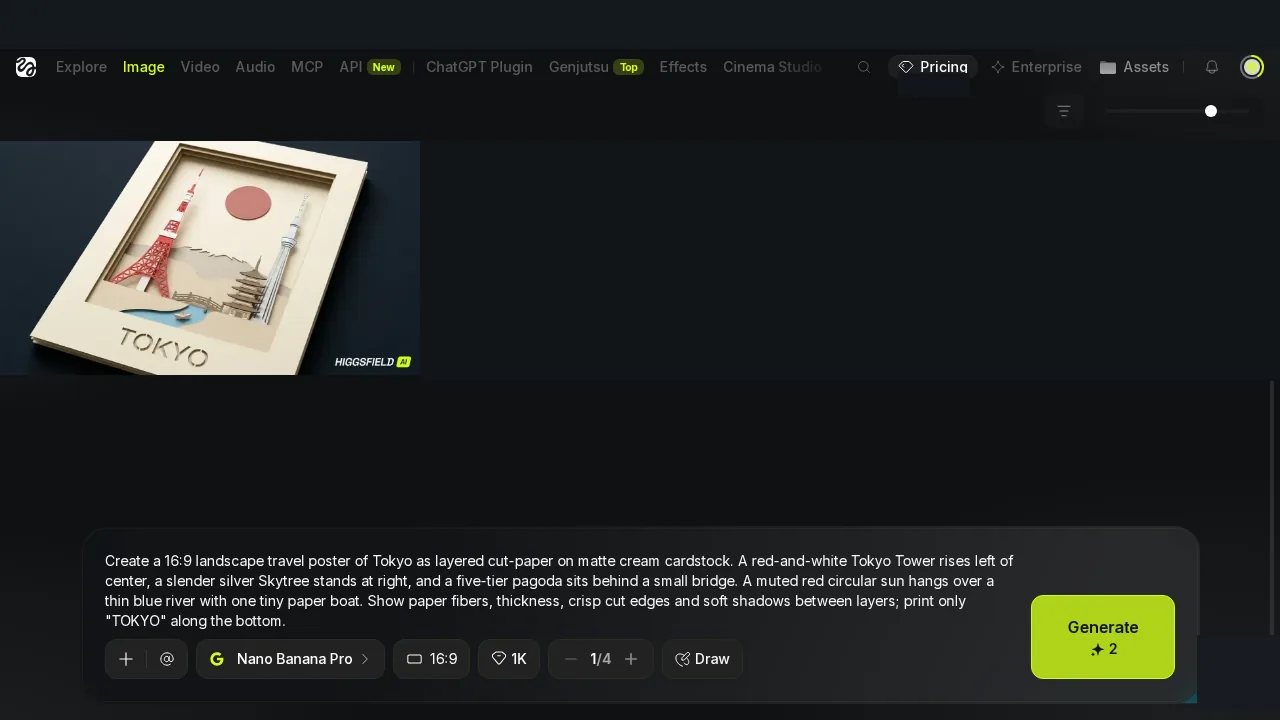
Higgsfield's first completed image card, distinct from the untouched PNG used for the watermark observation.
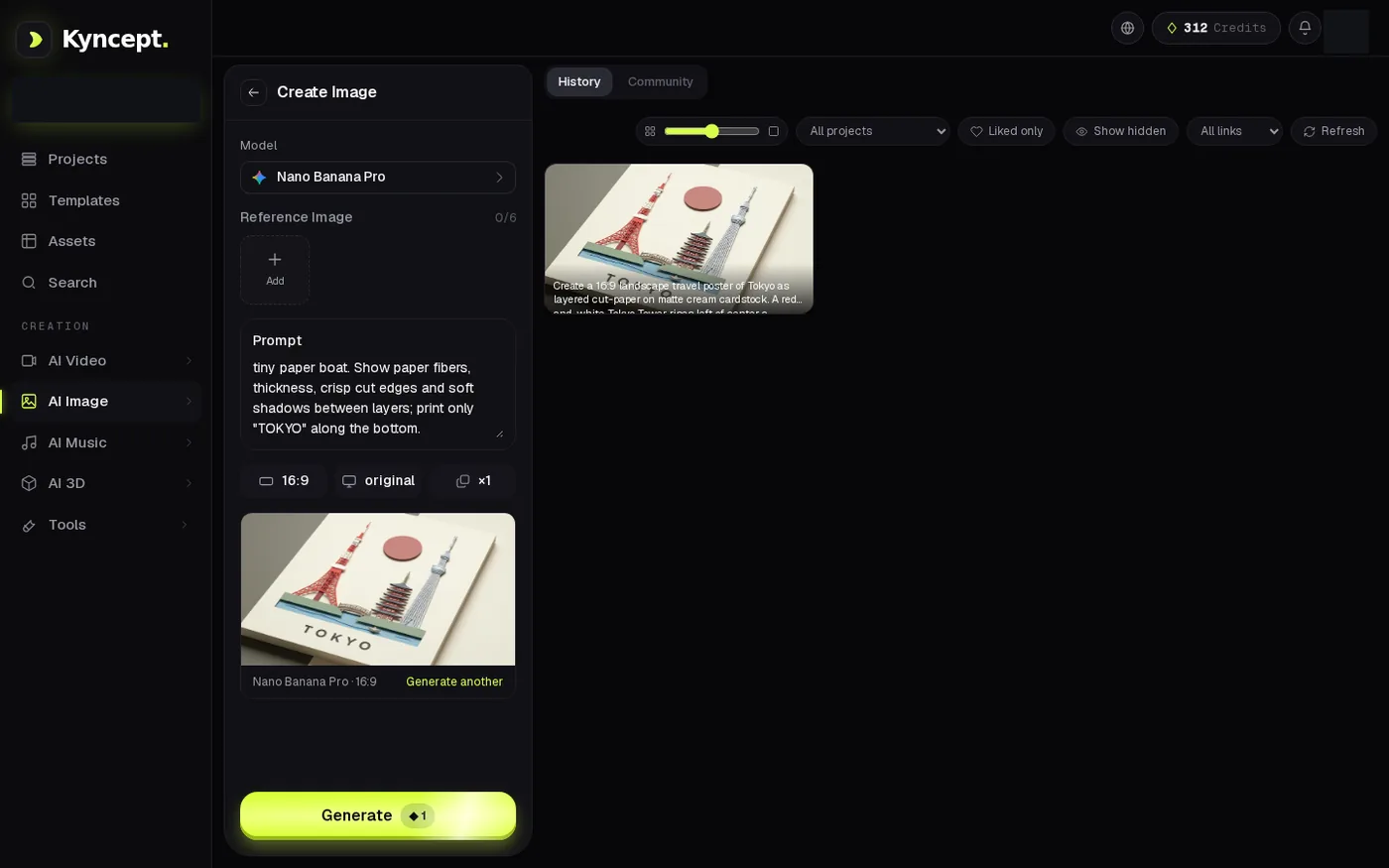
Kyncept's first completed image card. The file itself, not this card, is the basis of the format and watermark check.
Pair two: the canvas is landscape, but the poster can be portrait
Higgsfield image 2 presents a portrait-style cream poster sitting in the middle of a broad landscape background. Tokyo Tower is left of center within the poster, Skytree is right, and “TOKYO” sits on its lower edge. The actual PNG canvas is still 1376×768. Saying the file was exported in portrait orientation would confuse the geometry of an object inside the picture with the geometry of the file.
Kyncept image 2 spreads the landmarks across a wider landscape composition, with a pagoda and small bridge above the river and “TOKYO” centered below. It more literally reads as a horizontal poster to us, but one more literal reading of landscape does not establish a general image-quality winner. The other three outputs also differ in style and framing. Anyone with a strict art direction should review both full-resolution originals rather than decide from a thumbnail.
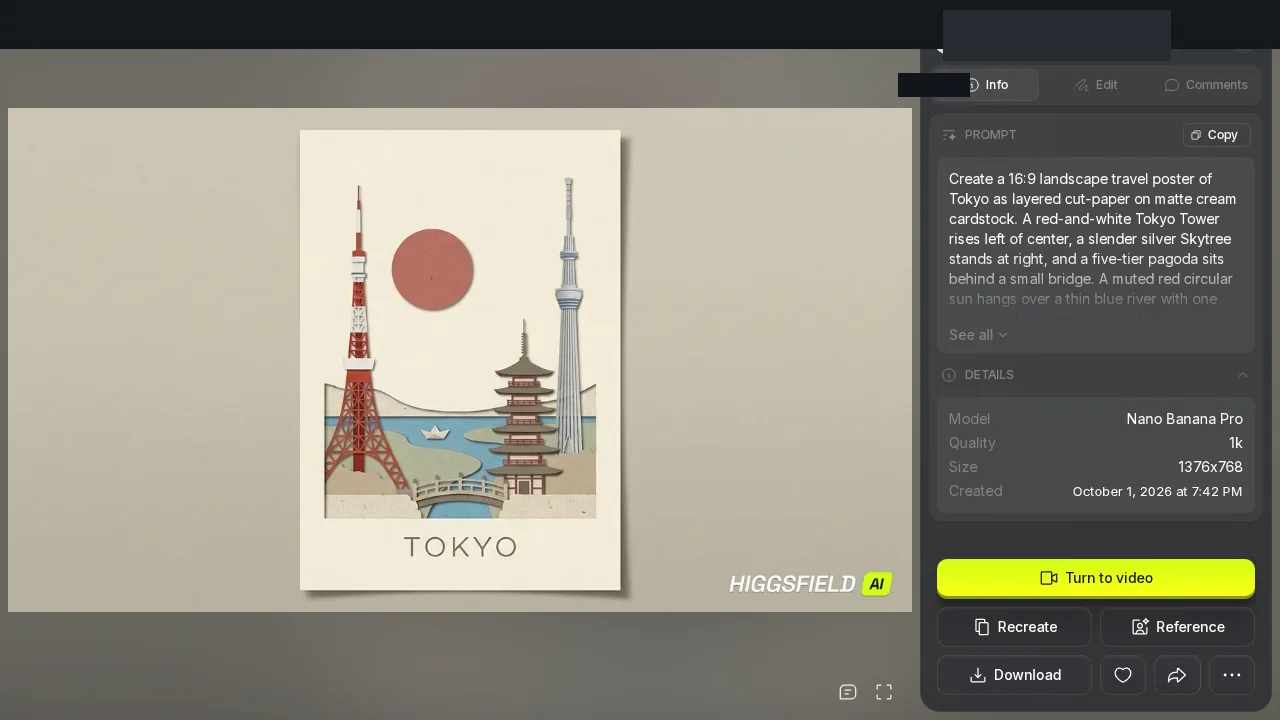
Higgsfield image 2: a portrait-oriented poster object inside the landscape 1376×768 original. The raw-file watermark remains visible at right.
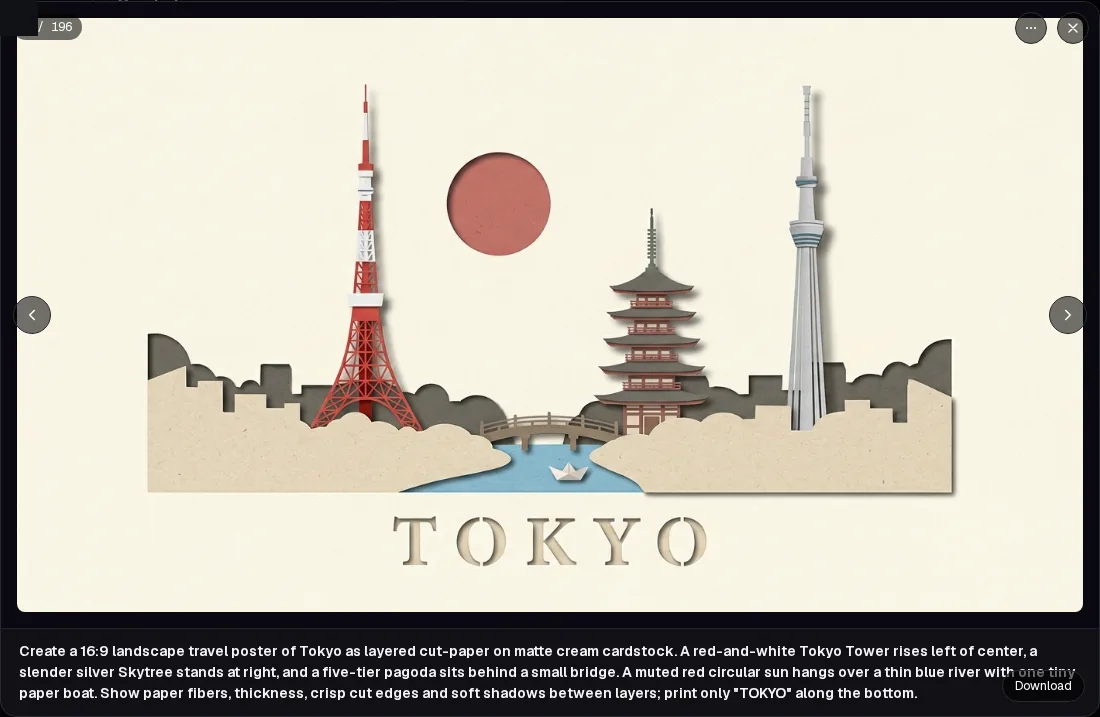
Kyncept image 2: a broader treatment of the same written brief, without a visible brand mark in the inspected original.
Why 1376×768 is not mathematically exact 16:9
A true 16:9 ratio is about 1.7778, while 1376 ÷ 768 ≈ 1.7917. All four sources share that slight deviation even though both UIs displayed 16:9. That is a file fact, not evidence that one product alone ignored a ratio request. The difference is roughly 0.8% of the nominal width-to-height ratio, and a 1376-pixel-wide file would need a height of 774 pixels for exact 16:9. These figures are simple geometry, not an aesthetic rating or an assertion about unseen export settings.
At 300 pixels per inch, the shared 1376×768 source represents roughly 4.59×2.56 inches without upscaling. That calculation does not establish print suitability for a larger physical poster. Both sides have the same pixel count; composition is the meaningful difference here.
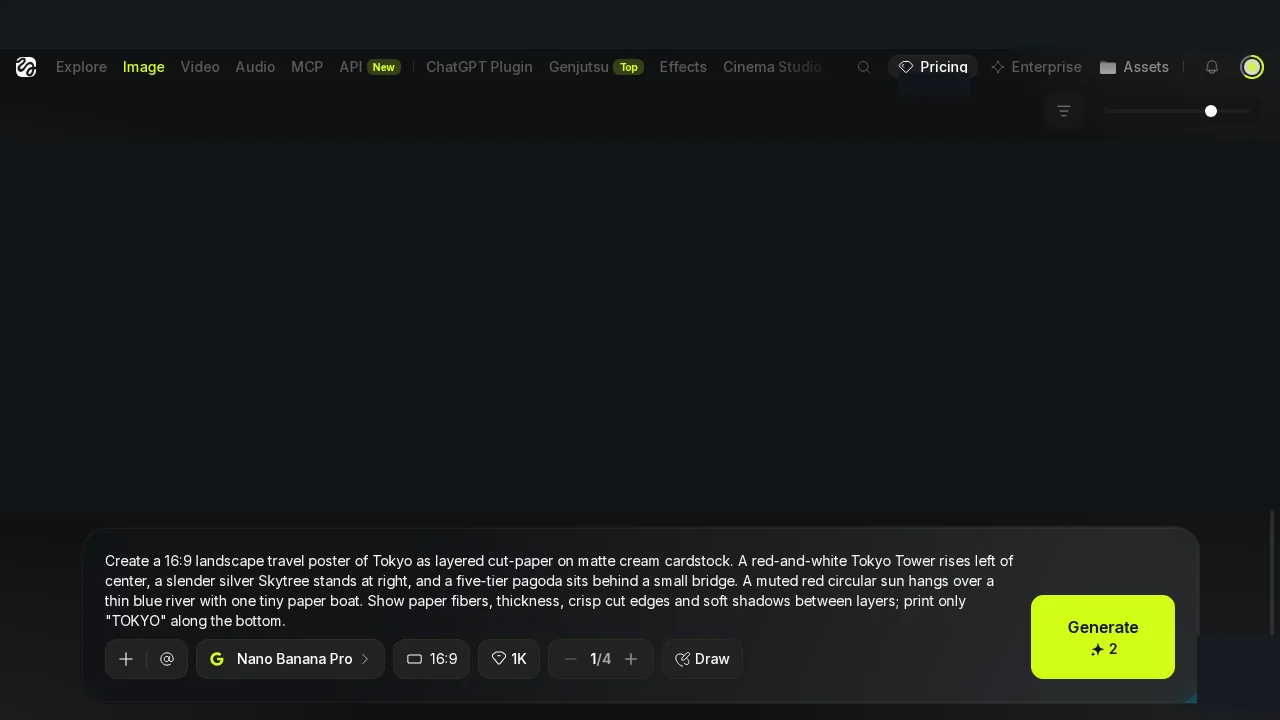
Higgsfield's image settings display Nano Banana Pro and the selected landscape ratio.
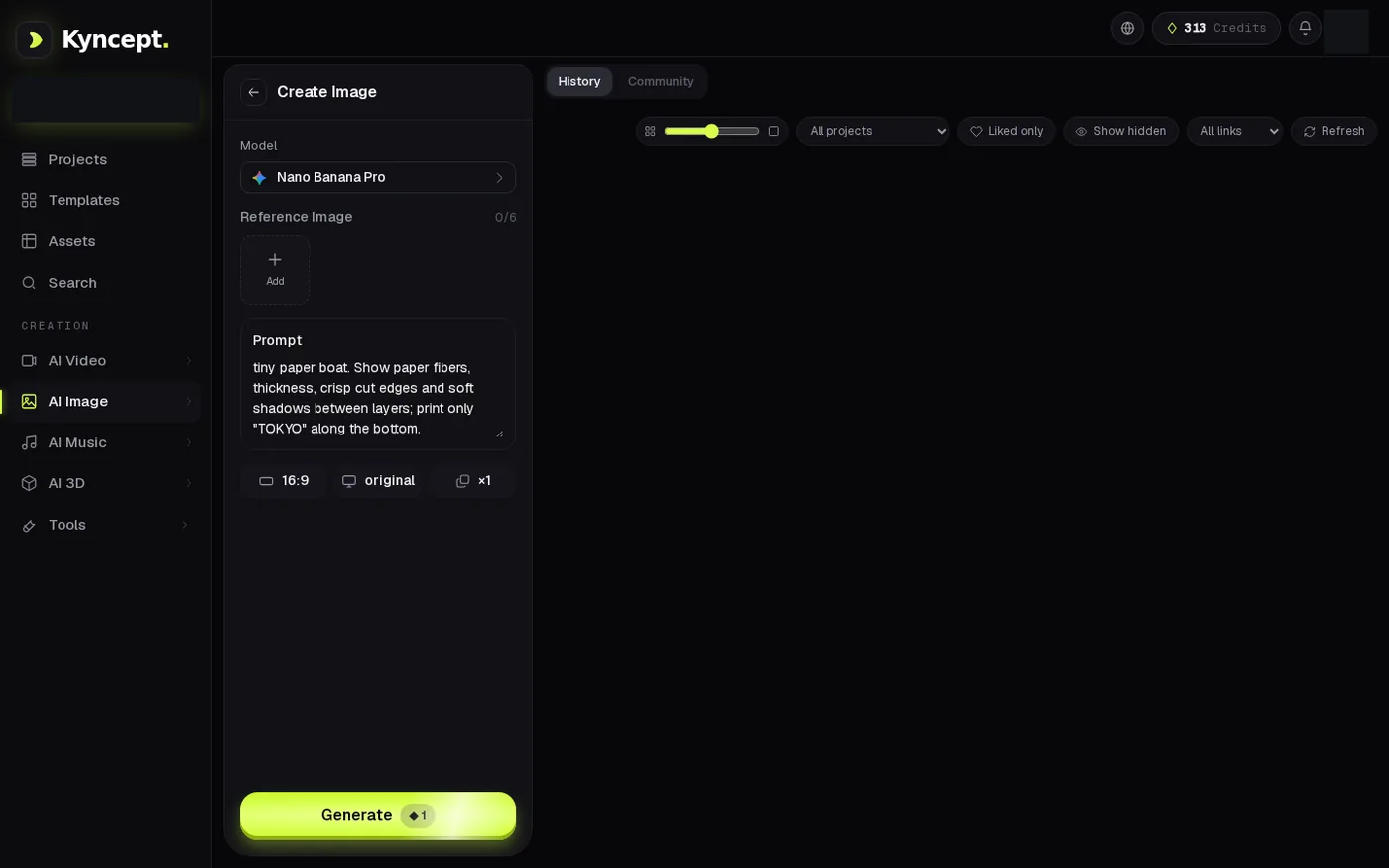
Kyncept's matching model label and 16:9 selection. Neither screen guarantees an exact mathematical file ratio.
A watermark seen in an original is different from a page overlay
Both downloaded Higgsfield PNGs include the HIGGSFIELD AI mark in their lower-right pixels. A screenshot of a website might contain logos imposed by its preview UI; checking the raw file removes that particular ambiguity. Neither of the two inspected Kyncept JPEGs shows a comparable brand mark. The claim is deliberately bounded to these four originals and the respective accounts/settings used for the case. We did not buy or validate a paid watermark-removal benefit, and we cannot tell a reader that every future generation or paid tier will behave the same way.
The prompt said “print only TOKYO along the bottom,” so the extra Higgsfield mark matters when the file itself is the deliverable. It does not mean that the illustrated landmarks, paper fibers or text rendering are bad. Separating content fidelity from export packaging allows a fairer quality tie alongside an unambiguous watermark difference.
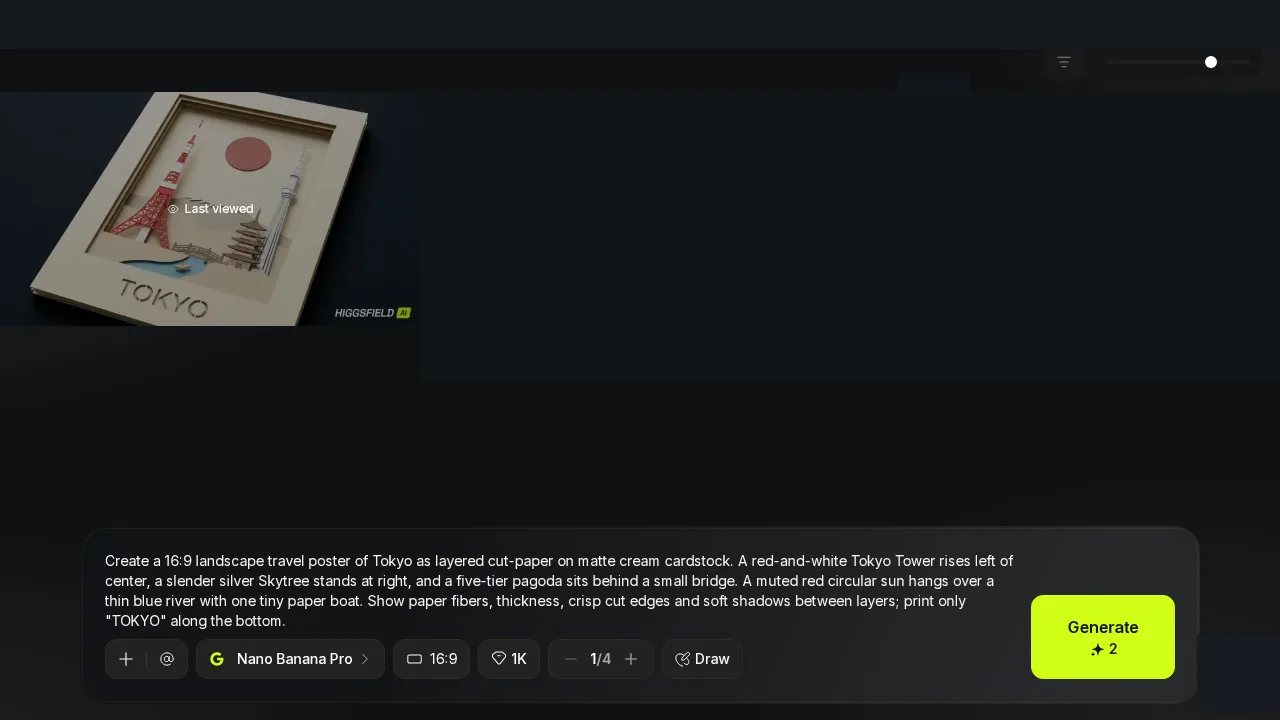
The second Higgsfield request used the same model and artwork prompt; the second raw PNG also retains the brand mark.
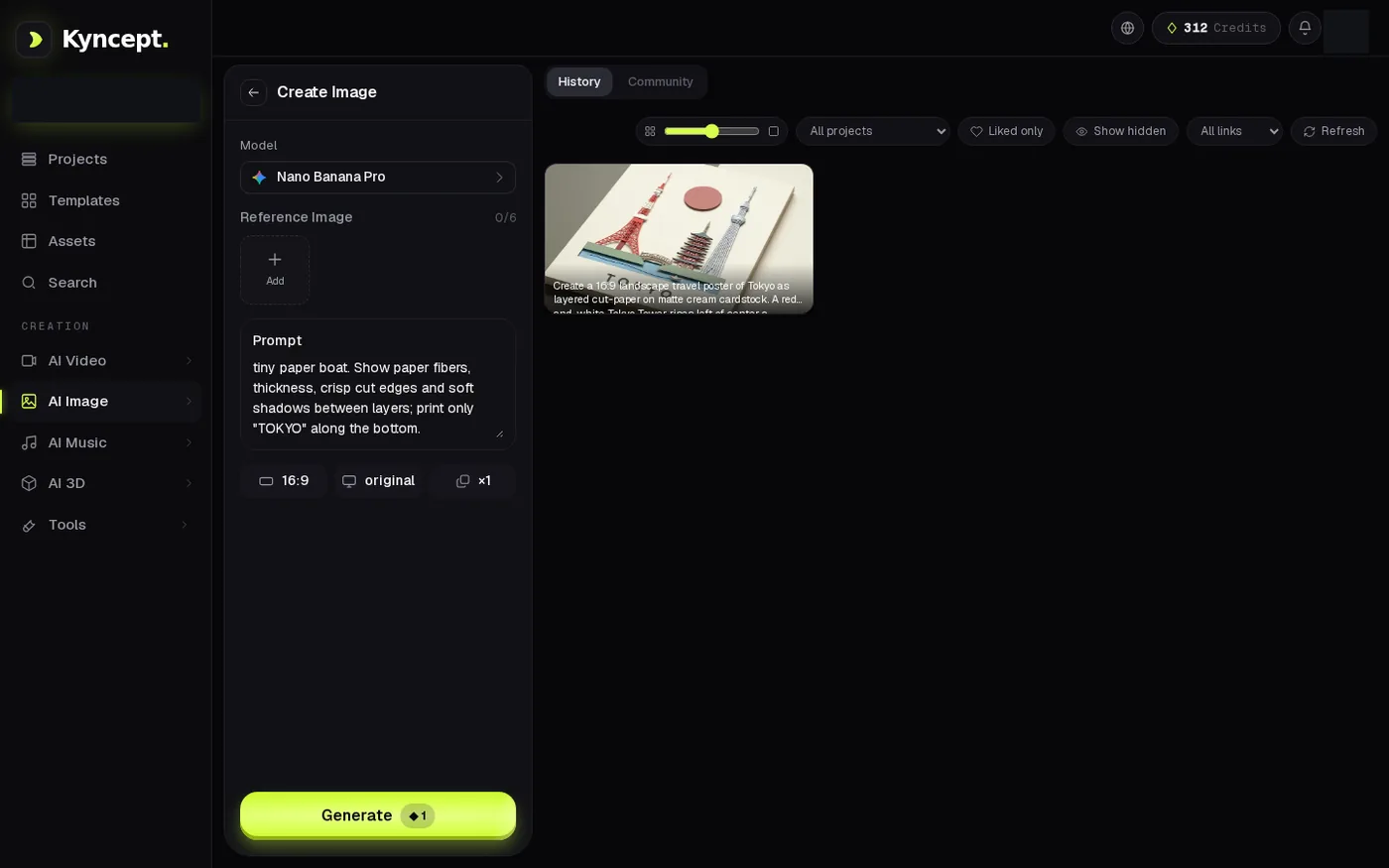
The second Kyncept request used the same written prompt, producing a different layout from the first run.
PNG versus JPEG: do not grade quality by byte count
Higgsfield's two originals are PNG RGBA at 1,645,817 and 1,336,001 bytes. Kyncept's are JPEG RGB at 697,068 and 688,508 bytes. The PNGs are larger, but lossless-style packaging and compressed JPEG packaging carry different overhead and encoding decisions. We did not run a calibrated perceptual quality study or export both versions into the same codec, so “half the bytes means twice the quality” would be a non sequitur.
For a purely illustrative 12 Mbps transfer with no handshake, overhead or local write time, the raw file sizes imply about 1.097 and 0.891 seconds for the two Higgsfield files, versus 0.465 and 0.459 seconds for Kyncept's. Those seconds are a formula on file size, not measured download timings, and file size is not a stand-in for detail. The report's derived data records the assumption so it is easy to change.
Credits show local debits, not cross-platform dollars
Higgsfield's image balance ran 6→4→2, two Higgsfield credits per completed image. Kyncept's ran 313→312→311, one Kyncept credit per image. These are direct before/after observations. On the separately documented public $59/1,200-credit monthly bundles, proportional full-use allocation would be about $0.09833 for a Higgsfield image and $0.04917 for a Kyncept image. That is not a claim that the trial incurred either dollar charge or that credits have a universal exchange rate. The pricing article lays out the assumptions, including what happens when credits go unused.
An editor requiring an unaltered file without a visible brand mark would need to account for what the two Higgsfield originals contain. That is a batch-specific observation, not advice to remove a watermark.
An exact UI timer cannot be manufactured from another clock
For Higgsfield image 1, the first client network response marked completed at +31.698 seconds after Generate. Its exact UI-completed second was not captured. A later read-only screenshot proves completion but does not fill the gap. Higgsfield image 2's UI card showed completion at +41.338 seconds; its fully drawn pixels appeared shortly afterward. The 41.338-second datum is the card status, not the instant the last pixel became visible.
For Kyncept image 1, the UI showed completion at +53.073 seconds. Kyncept image 2 was still generating at +295.8 seconds, and a subsequent read showed it done no later than +369.4 seconds. Its precise completion moment lies in (295.8, 369.4] seconds, not at either endpoint by fiat. Converting Higgsfield's first network result to UI time, or replacing the Kyncept interval with a guessed midpoint, would create false precision and a false speed ranking.
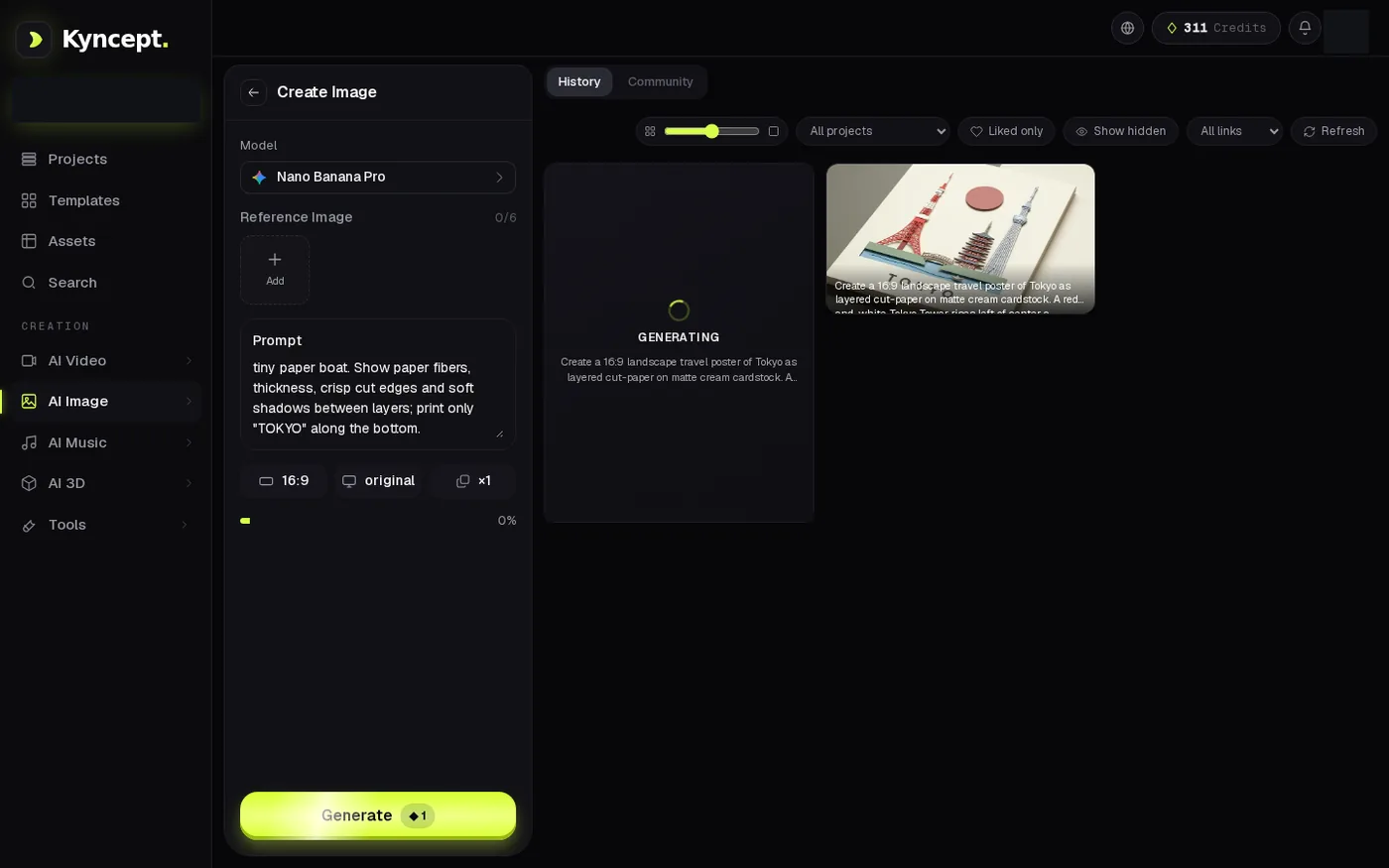
The second Kyncept image is still shown as generating; the interval bound comes from the timed watcher, not from a clock printed in this screenshot.
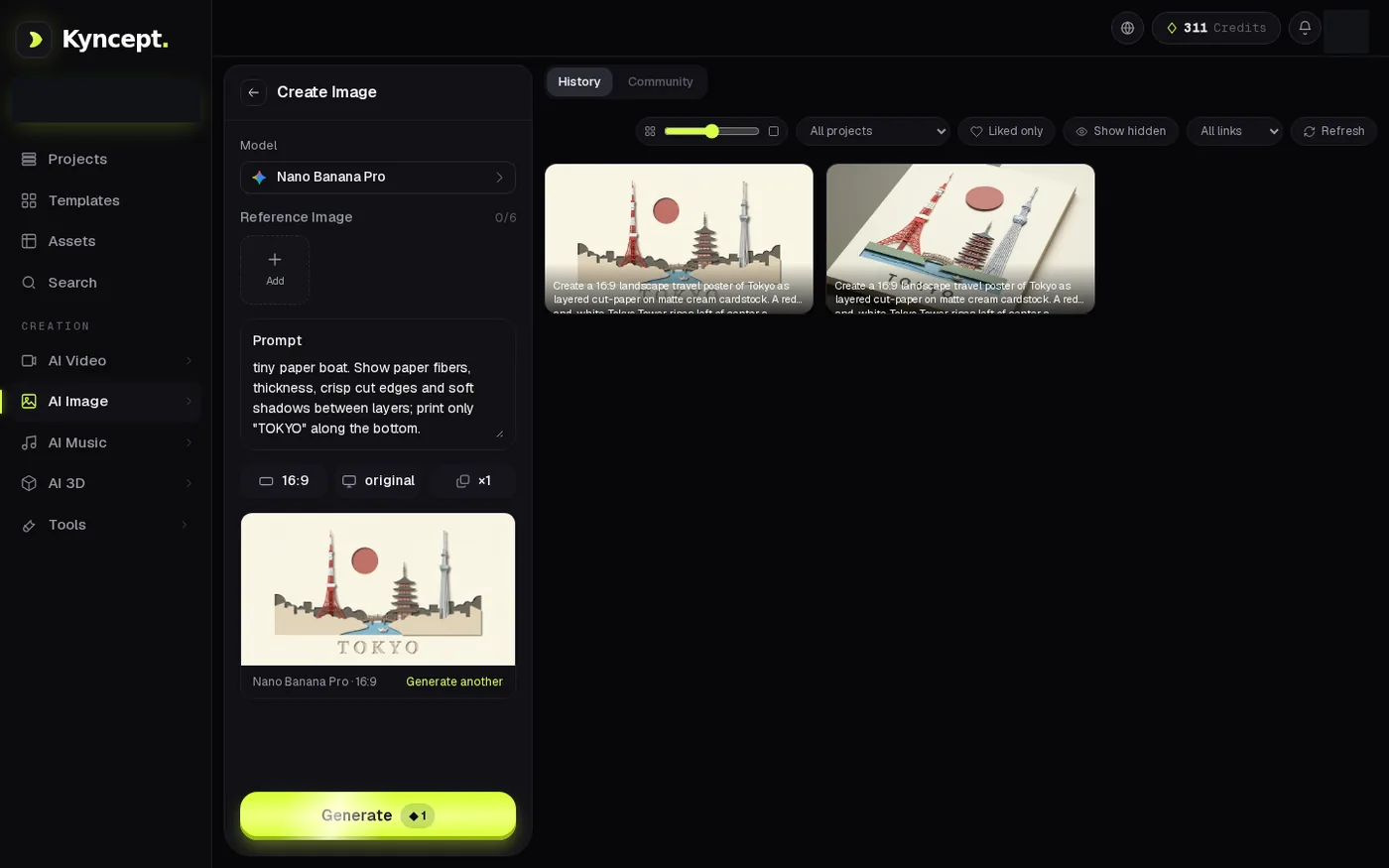
A later read finds the second Kyncept image completed, without establishing its exact completion second.
What these four outputs can and cannot decide
Matching model labels, text and file dimensions make this a useful single-prompt illustration. It does not control random seeds, server load, entitlements or output codecs. Neither the slow, interval-bounded Kyncept run nor Higgsfield's network completion defines typical UI speed; commercial-license terms were not tested.
Both sides drew recognizable Tokyo paper layers. Kyncept image 2 uses the landscape area more directly; Higgsfield's two originals carry a brand mark; formats and byte sizes differ. Open the four raw assets to check those facts or disagree with the subjective tie.
Final verdict: a visual tie with an export caveat
On visual content from two Nano Banana Pro images per side, calling a universal image-quality winner would be stronger than the evidence. In this batch, both products delivered serviceable paper Tokyo scenes; the watermarked Higgsfield PNGs and the clean-looking Kyncept JPEGs differ in a directly inspectable way. One Higgsfield UI time is missing, and the second Kyncept UI time is interval-censored, so this article does not convert a messy stopwatch into a speed claim. That subjective tie coexists with differences in composition and packaging.
Which one I would use for this job
For a layout-sensitive poster brief, I would compare the actual four files, not only the platforms' promotional thumbnails. If an untouched file with no visible brand mark is a hard requirement, the two Kyncept originals in this case meet that observation; the two Higgsfield originals do not. Kyncept's site provides the product entry point, while the report preserves the source files. Paid-plan rights, future watermark behavior and reliable speed remain questions for separate checks, not promises inferred from these four images.
Originally published on Medium: Higgsfield AI Image Review 2026: Four Tokyo Posters and a Watermark.