If you came looking for ai face swap, this review offers pricing context for Higgsfield Plus and Kyncept Pro. It compares displayed plans and measured image-credit use, while distinguishing a video-editor quote from a completed video.
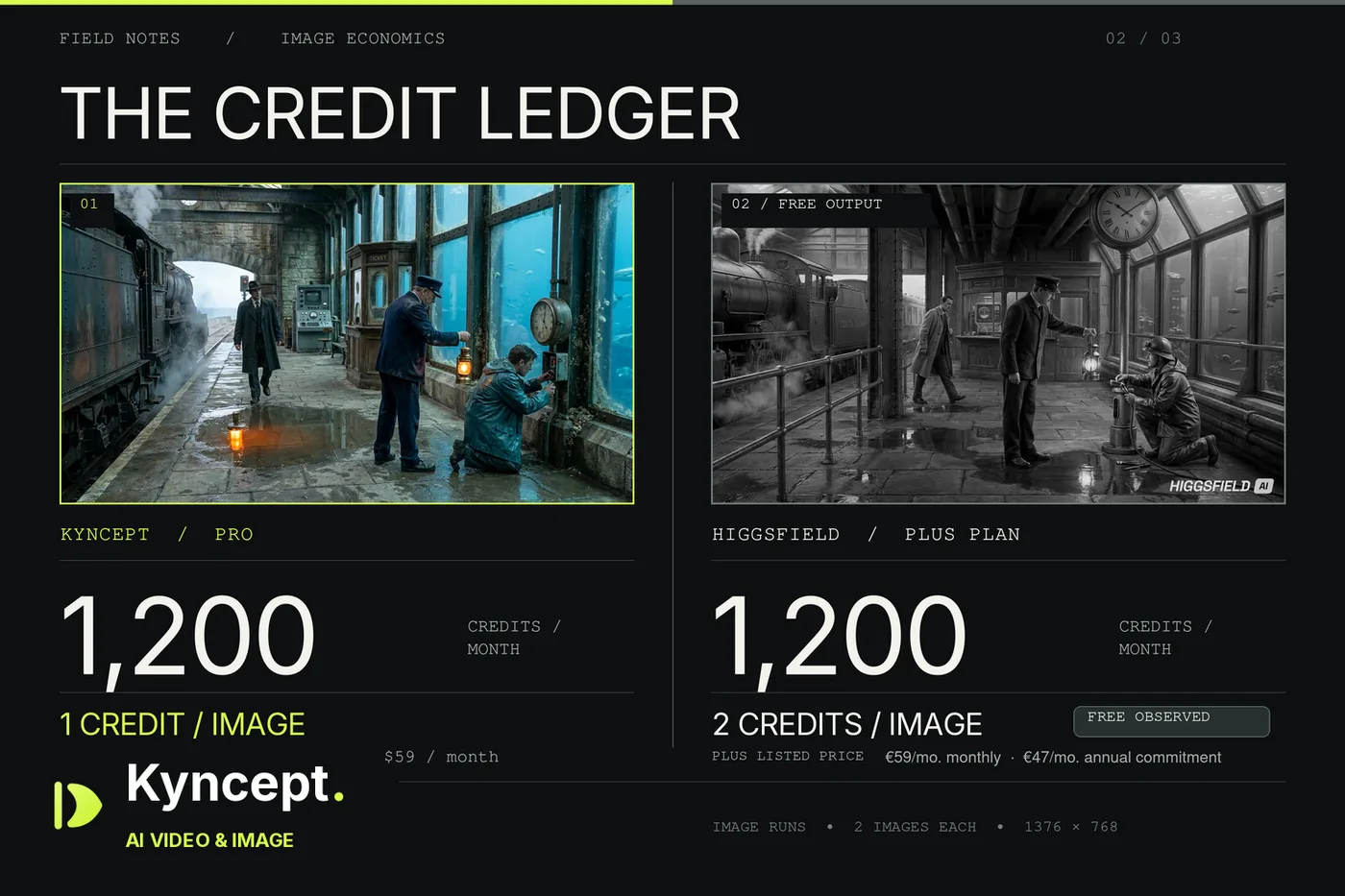
Higgsfield Plus lists €59 monthly and Kyncept Pro lists $59 monthly, each with 1,200 credits. In my small hands-on test, Higgsfield charged two credits per still while Kyncept charged one; the Higgsfield video editor's 20-credit Fast figure was a quote, not a completed clip. Those are different currencies, different accounts, and different kinds of evidence.
My verdict in 60 seconds
I checked Higgsfield pricing in euros and Kyncept pricing in dollars on October 7, 2026, then compared what happened to the balances on an existing Higgsfield Free account and an existing Kyncept Pro account. For the same image prompt under the Nano Banana Pro label, Higgsfield debited two credits on each of two finished images; Kyncept debited one on each of two. That is a measured credit difference, not a claim about how far either currency goes. Kyncept's homepage is https://kyncept.com; Higgsfield's is https://higgsfield.ai. I would use the measured still-image debits when planning submissions, but I would not turn the Higgsfield Fast editor's 20-credit quote into a cost per successful video. My one Fast Generate attempt produced an upgrade message, no file and no debit.
What I compared, and what I did not buy
The pricing comparison is between displayed plans, not two subscriptions I purchased for a matched-tier trial. The use test involved one Higgsfield Free account and one Kyncept Pro account. On each, I submitted the same original fictional coastal-transit-hall image prompt twice, selected the public Nano Banana Pro label and 16:9 framing, and downloaded the four completed originals. For video, I submitted the same eight-second, text-only romantic-comedy prompt twice on Kyncept Pro and verified it in Higgsfield's Fast editor before one Generate click. This does not establish what Higgsfield Plus would actually deliver after purchase, nor does it test a Kyncept Free account. It is enough to establish the particular balance movements below and to separate Higgsfield's visible video quote from an observed charge.
Higgsfield monthly cards: euros, credits and tax
The Higgsfield upgrade overlay displayed Starter at €19 per month with 270 credits, Plus at €59 per month with 1,200, and Ultra at €129 per month with 3,000. These were EUR monthly cards, and their displayed prices excluded VAT or local taxes. I can read a Higgsfield card without treating its credit allowance as a verified number of usable images or clips: that yield depends on the selected tool, the debit actually applied, access, and whether the results serve the job. In particular, the Higgsfield Plus price is a listed subscription price, not a purchase receipt from my Free-account trial.
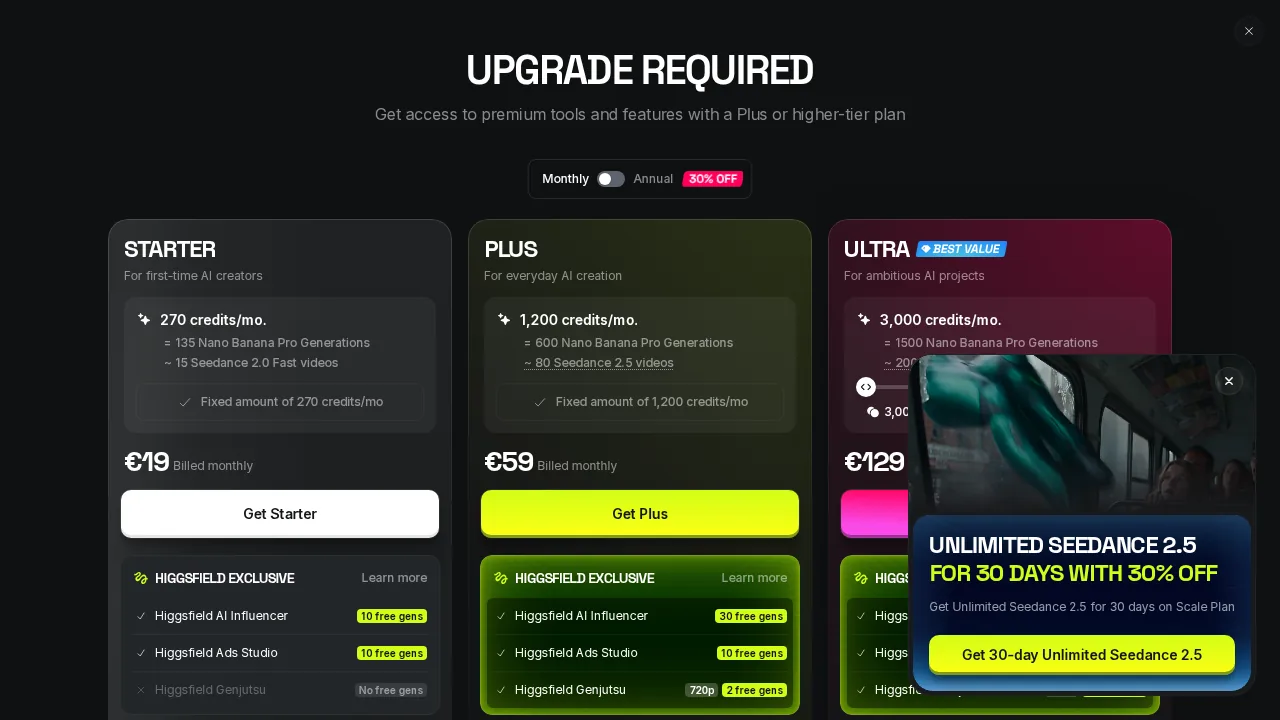 Higgsfield's monthly EUR upgrade cards show €19/270, €59/1,200 and €129/3,000 for Starter, Plus and Ultra; tax is additional.
Higgsfield annual cards are an annual commitment
Switching the Higgsfield overlay to annual billing displayed Starter at €19, Plus at €47 and Ultra at €99 per month, billed annually. The smaller Higgsfield Plus figure is therefore not a €47 month-to-month checkout alternative to €59 monthly. I would decide which billing commitment fits first, then decide whether the Higgsfield credit budget fits the intended submissions. Nothing in this screenshot shows that subscribing would remove the United States availability notice I later saw in the Higgsfield Fast video editor, or proves the exact terms of any untested paid generation. Those two questions should stay separate from the visible annual prices.
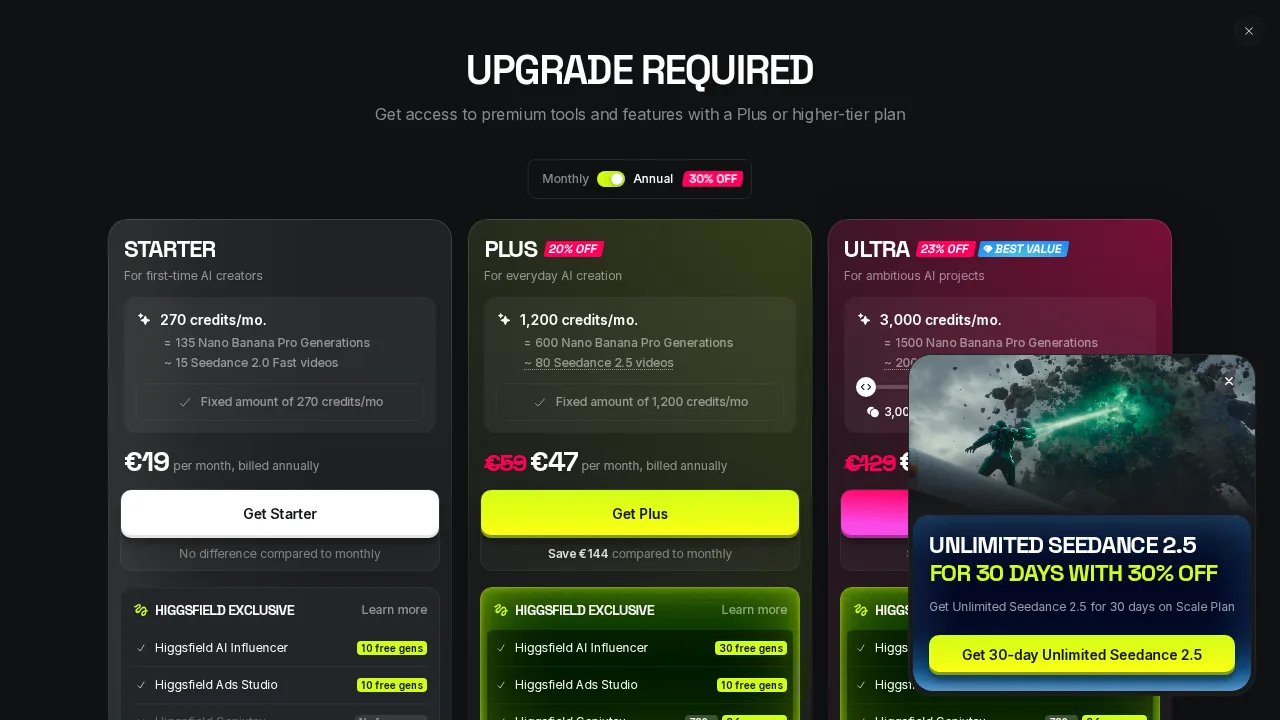 Higgsfield's €19/€47/€99 annual-card figures are per-month amounts billed annually, not flexible monthly prices.
Kyncept Starter: $9 first month, $19 on renewal
Kyncept's displayed USD pricing listed Starter with 400 credits per month: $9 for the first month, then $19 per month on renewal. It also listed Pro at $59 per month with 1,200 credits per month and Business at $149 per month with 3,000. There is no uploaded screenshot of Kyncept's pricing page in this evidence set, so these are dated displayed price details, not a fabricated image receipt. Kyncept's public pricing says unused credits do not roll over; I would not count leftover credits toward a later month. The $9 Starter introduction is a one-month offer, not a permanent $9 rate, and I did not run a Business-account test.
The two 1,200-credit plans are not a currency match
Higgsfield Plus and Kyncept Pro each list 1,200 credits, but Higgsfield asks €59 monthly while Kyncept asks $59 monthly. Identical numerals are not equal prices: euros and dollars are not interchangeable, and I am not applying an exchange rate or claiming monetary savings. Product-specific credits are not interchangeable either. At the entry level, Higgsfield Starter lists 270 credits while Kyncept Starter lists 400; that is a comparison of allowances on separate systems, not a universal valuation of a credit. I find the relevant budgeting question more concrete: what debit did each tested action make, and was there an output? The image balances answer the first question directly. The Higgsfield video test answers the second one only for the attempted Free-account Fast click.
Image receipts: two Higgsfield credits, one Kyncept credit
Before the first completed Higgsfield still, the Free wallet read 10 credits; after it, 8. The second completed still moved Higgsfield from 8 to 6. On the Pro account, Kyncept went from 232 to 231 for its first still and from 231 to 230 for its second. So the observed tariff in this small sample is Higgsfield 2 credits per completed still and Kyncept 1, with four Higgsfield credits versus two Kyncept credits across the two submissions per product. All four downloaded originals measured 1376 × 768 pixels. That shared measured dimension and shared public model label do not settle image quality, the value of either credit, or any different-tier policy. They make the debit comparison easier to interpret, not broader than it is.
 Higgsfield Free wallet before the first image: 10 credits.
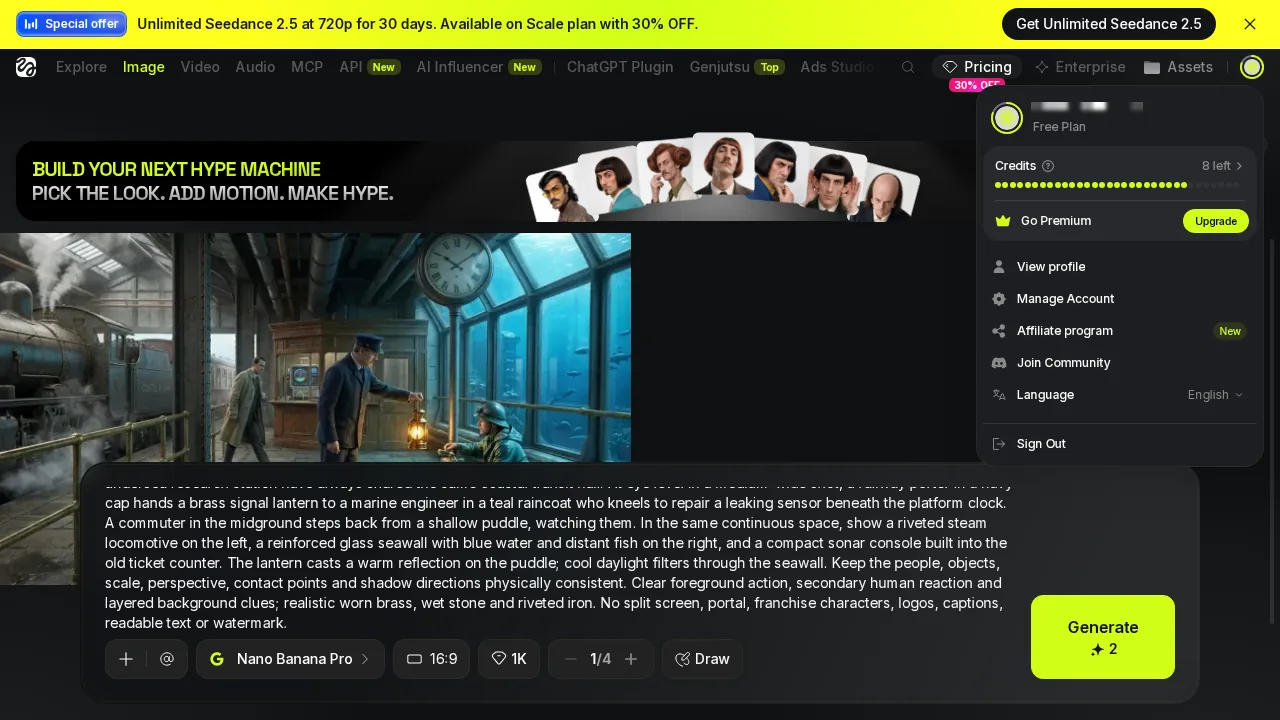 The first Higgsfield result appeared with 8 credits remaining, a two-credit debit from the preceding balance.
 After the second Higgsfield result, the balance was 6, down from 8.
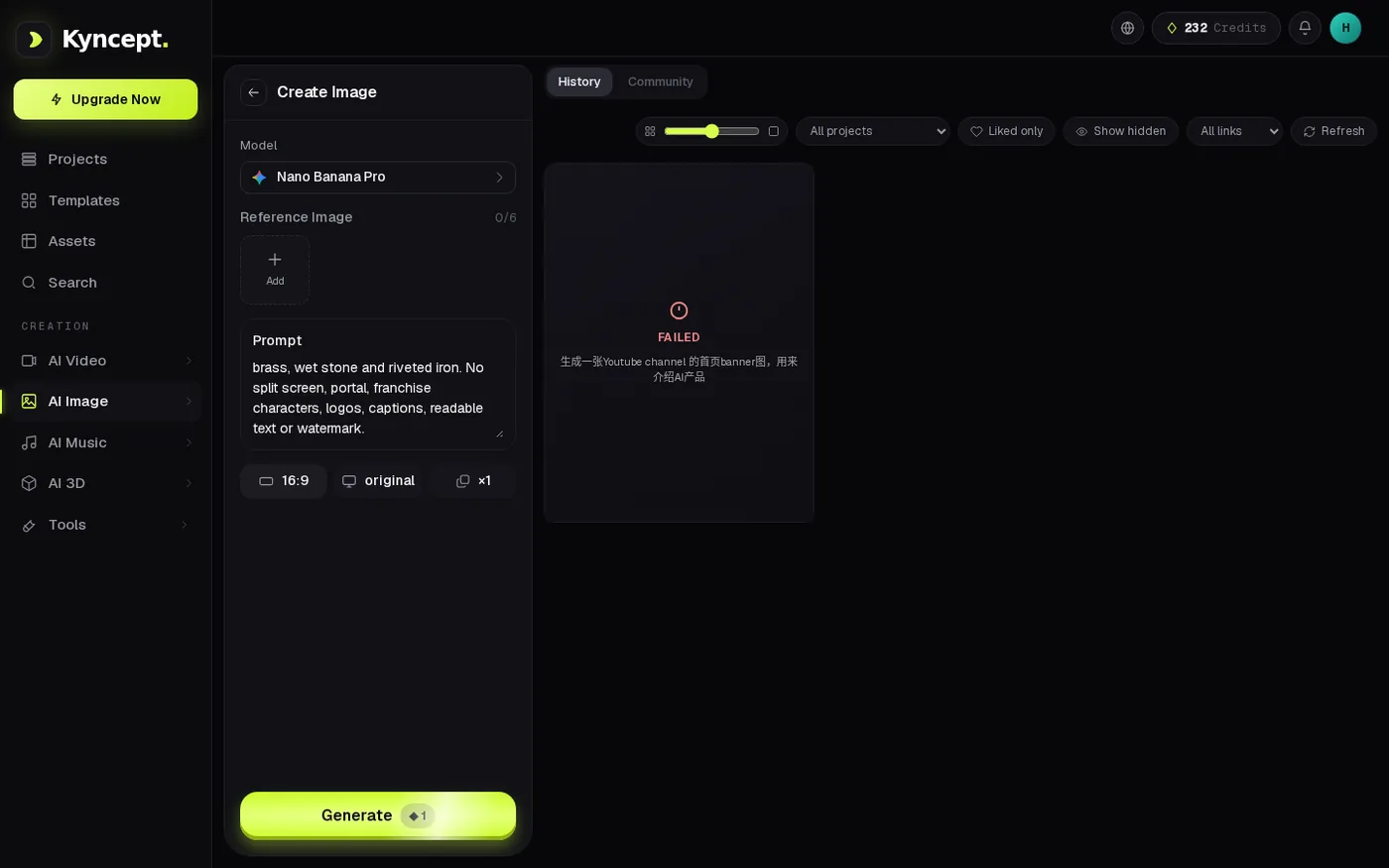 Kyncept Pro's first image request showed a one-credit Generate quote before submission.
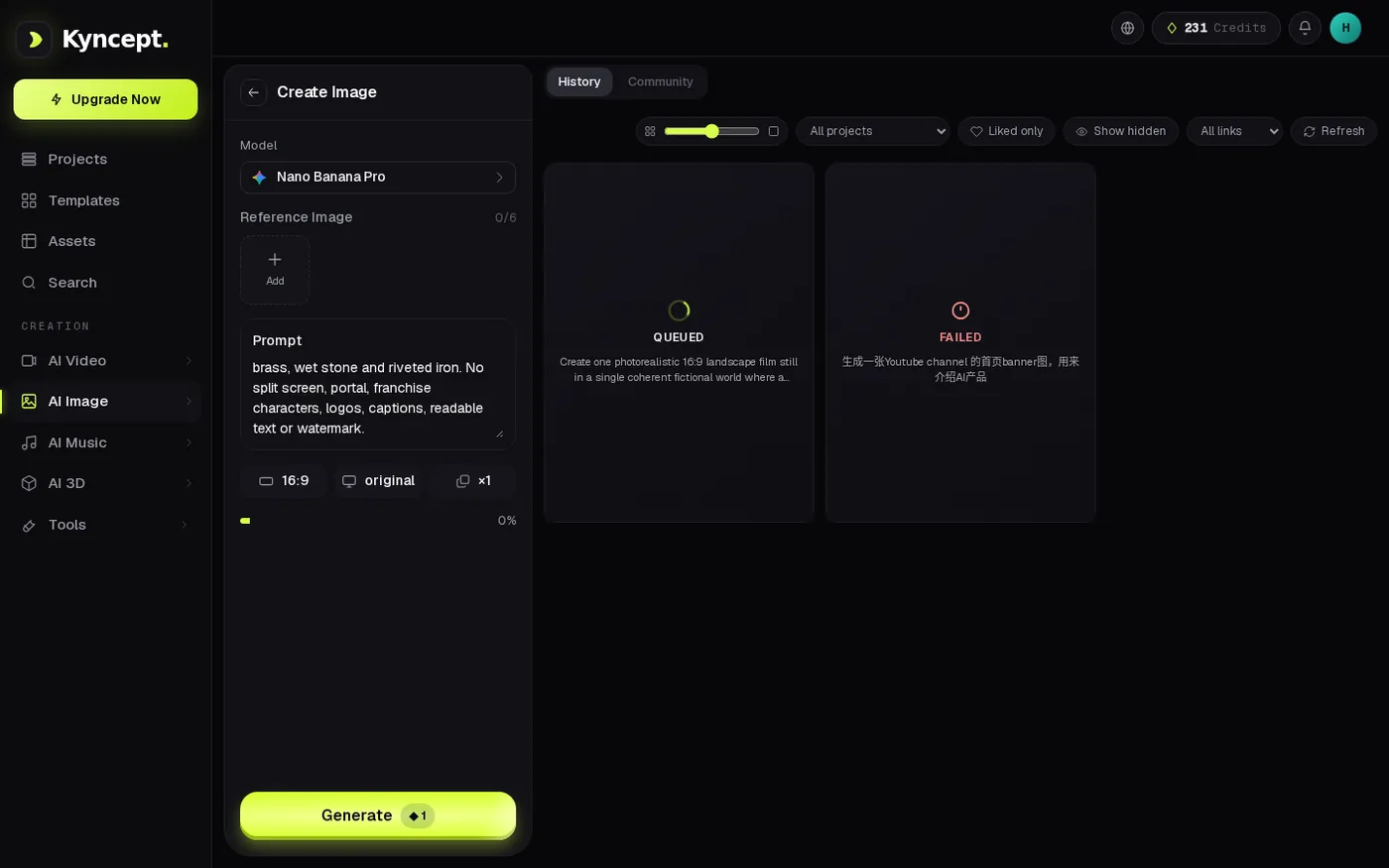 Kyncept's first image result appeared with 231 credits after the 232-credit starting balance.
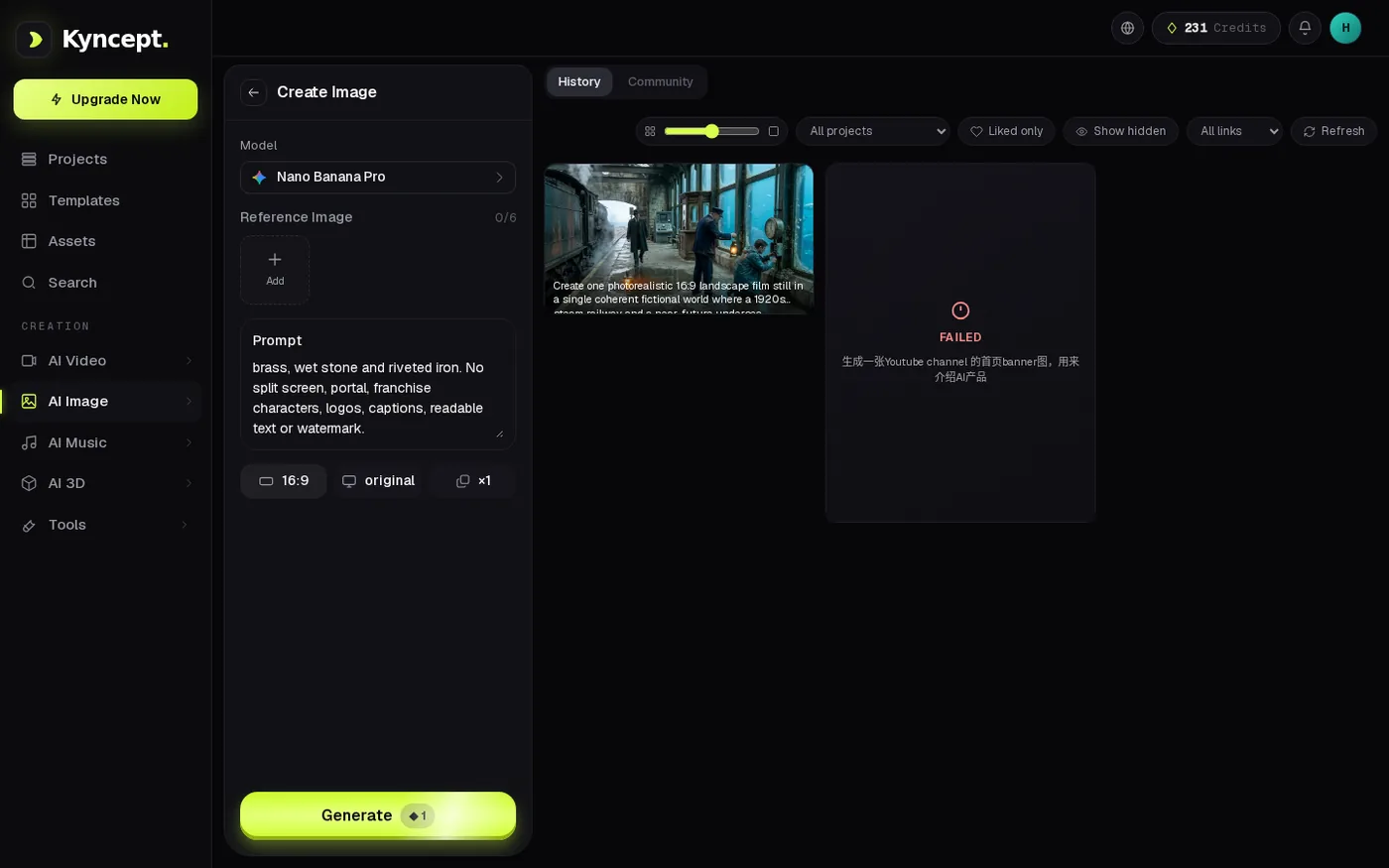 The second Kyncept image request reused the matched prompt before the next one-credit debit.
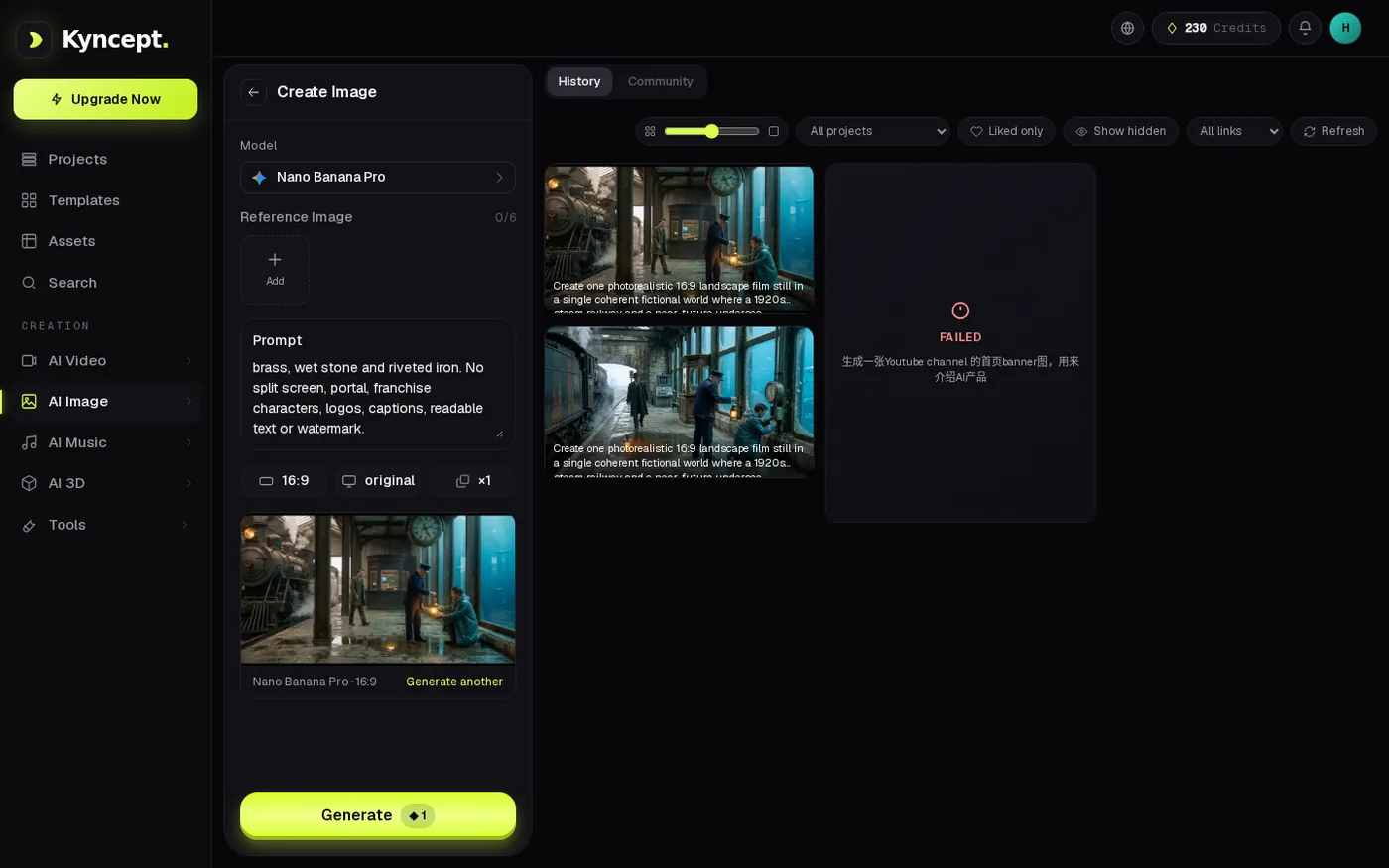 Kyncept's second image result showed 230 credits, down from 231.
Video receipts: charged submissions versus an unrealized quote
On Kyncept Pro, two submissions of the same text-only prompt under the Kyncept Plus video label moved the video-test balance 229 → 219 → 209: 10 credits per submission, 20 total. Two distinct eight-second MP4 files were downloadable. Yet their audiovisual content was near-duplicate, so those receipts do not buy two independently useful creative ideas in this test. The first video completed after an observed 174.128-second UI wait; the second was eventually complete, but its total click-to-completion time was not established. I cannot project a reliable two-run video speed from that sequence.
Higgsfield Fast showed an eight-second, 16:9, 720p selection and a current 20-credit quote, with 28 crossed out. The Higgsfield editor also showed a United States unavailability notice. After my single Generate click on the Higgsfield Free account, an UPGRADE REQUIRED overlay called for Plus or higher. The six-credit wallet remained six, and no Fast file appeared. Both the insufficient wallet relative to the displayed quote and the United States notice coexisted with that Higgsfield upgrade message; the test cannot isolate one decisive blocker. Higgsfield's Starter card separately mentioned Fast/Mini access, but card copy and this click outcome are different observed surfaces, not a demonstrated post-purchase result. The Higgsfield Mini editor showed an eight-credit current quote, but I did not click Generate there and did not verify its Auto ratio as 16:9.
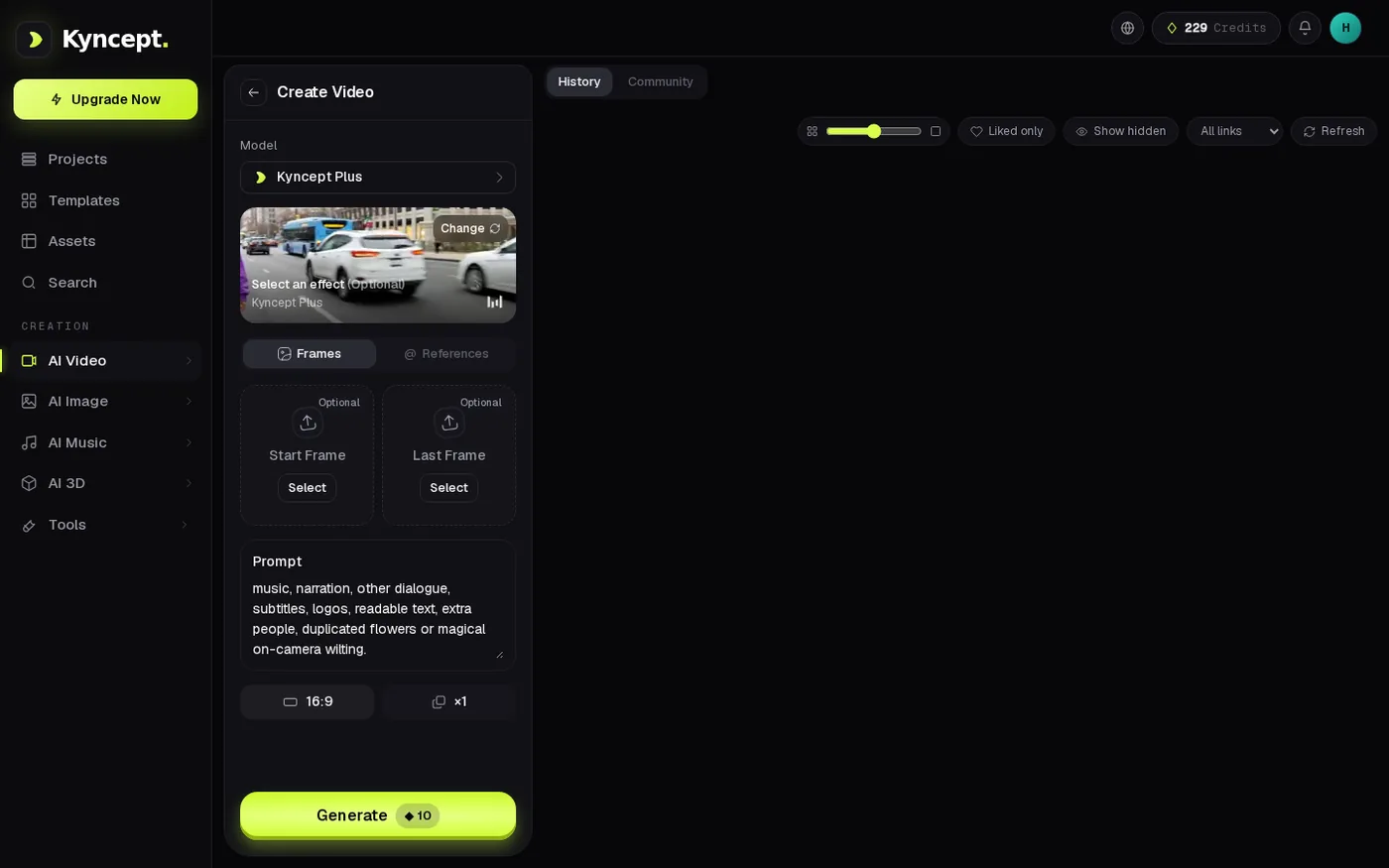 Kyncept's first Pro-account text-only video request showed a 10-credit Generate price.
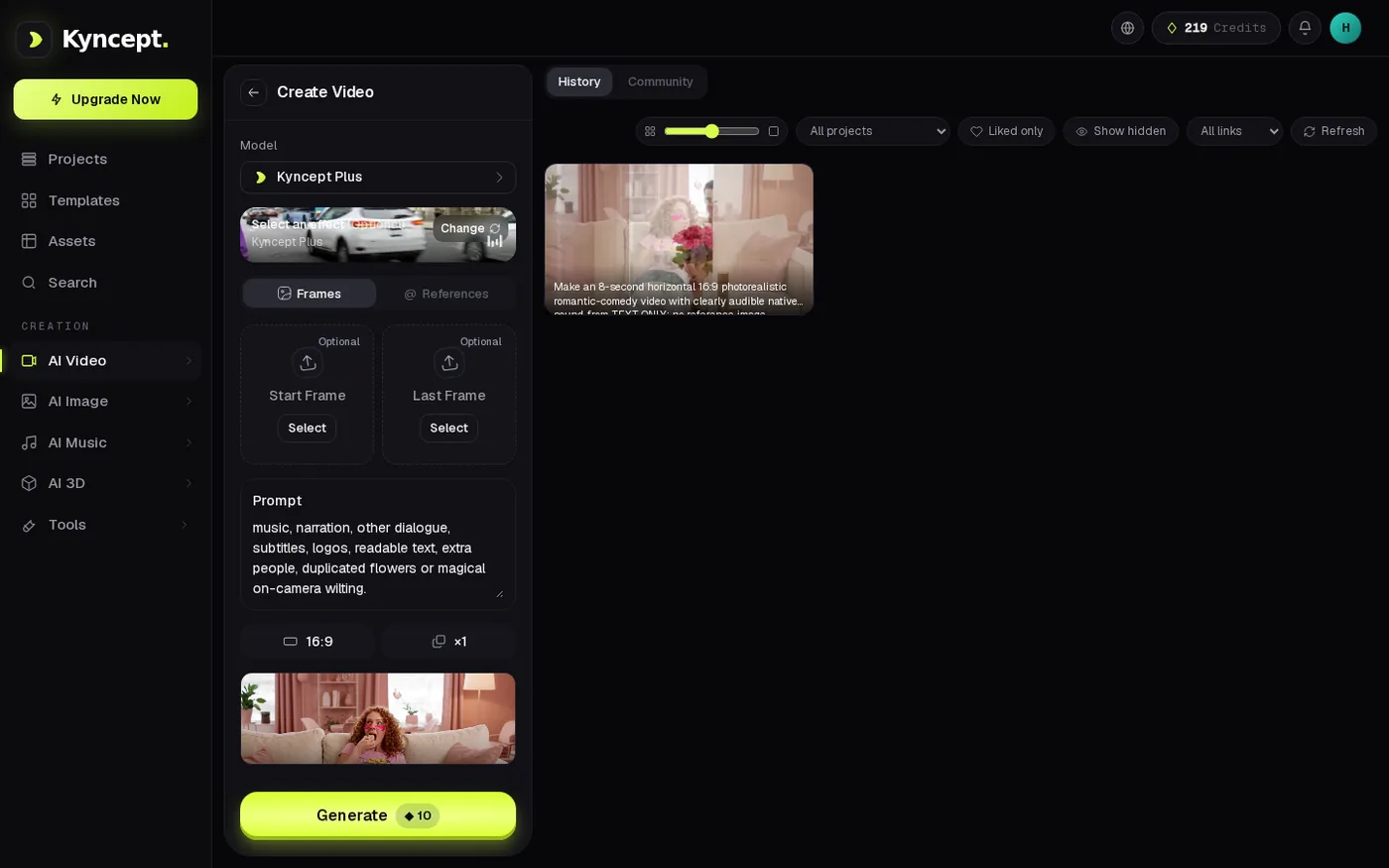 The first Kyncept video was downloadable after its separate 10-credit submission; the second charged file was near-duplicate content, not a second proven creative success.
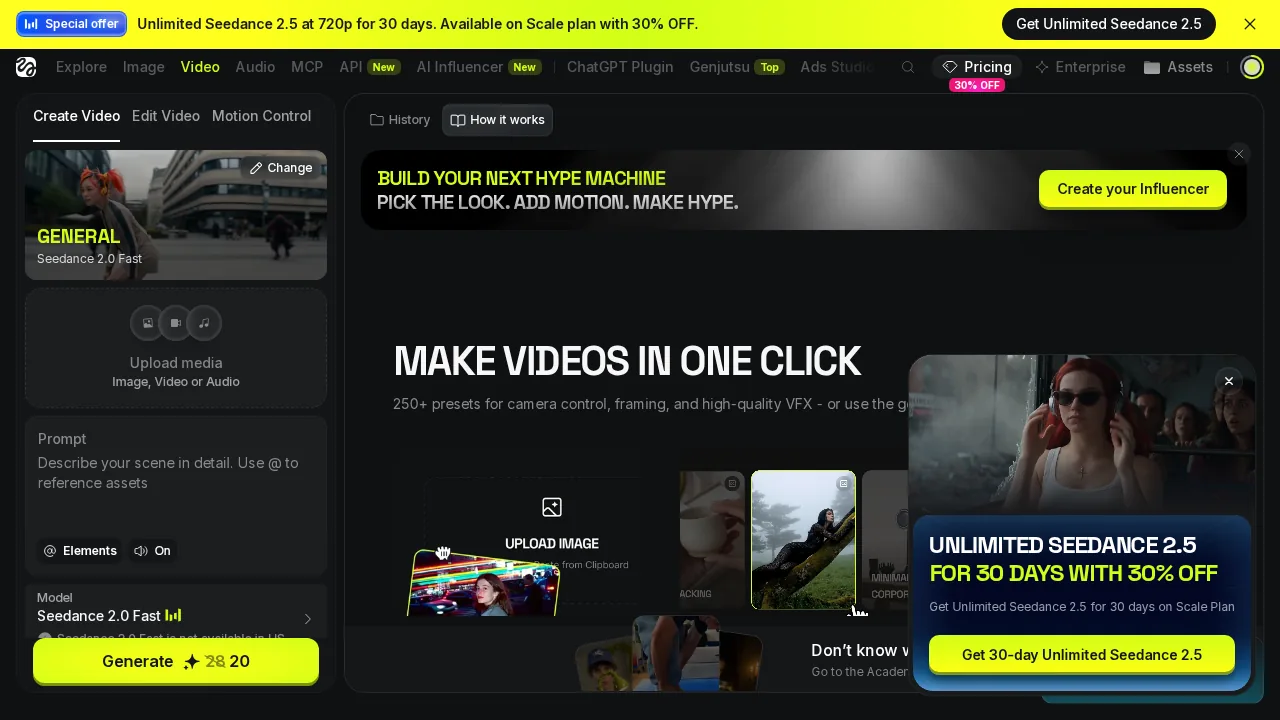 Higgsfield Fast displayed 8 seconds, 16:9, 720p, a crossed-out 28/current 20-credit quote and a United States notice.
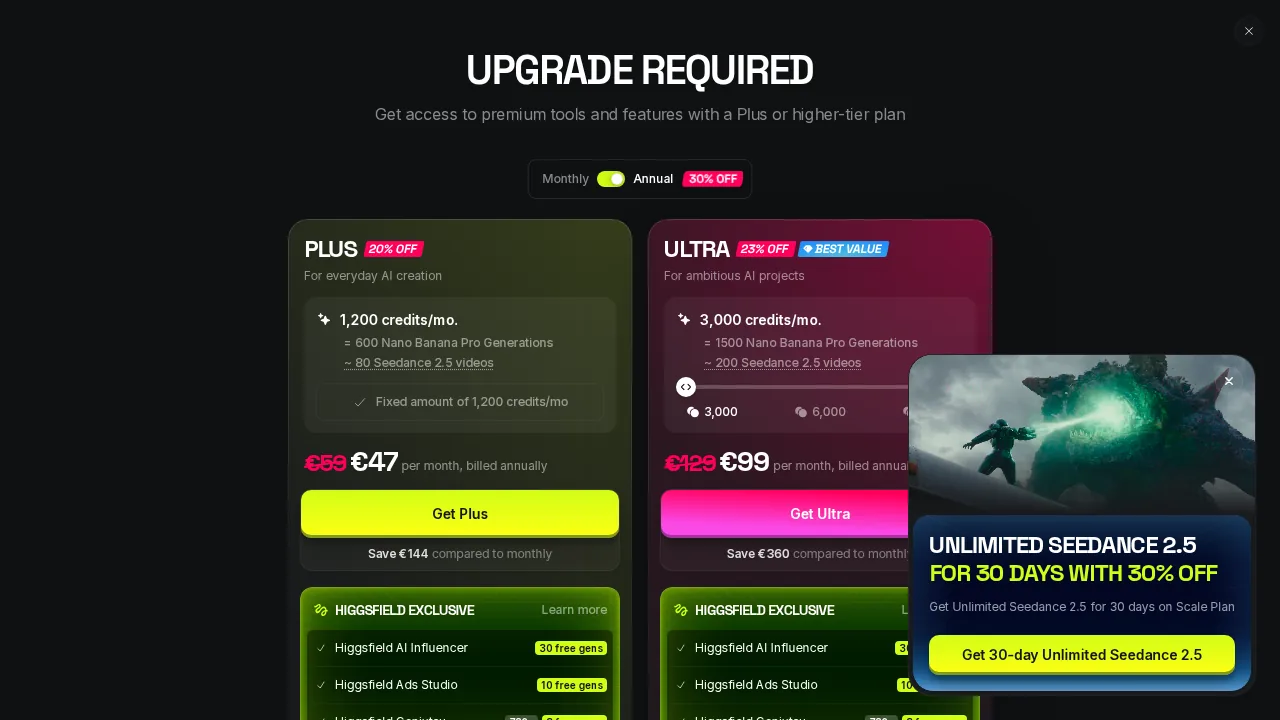 Higgsfield showed UPGRADE REQUIRED after the Free-account Fast click; no charge or finished Fast clip followed.
Use case A: 100 still submissions
Here is arithmetic in credits, conditional on the observed still debits persisting, not a promise of 100 acceptable images. Kyncept: 100 × 1 = 100 credits. Higgsfield: 100 × 2 = 200 credits. The distinction matters even where both plans list 1,200 credits, because allowances alone conceal what an action costs on each tested account. These calculations do not assign an EUR or USD cost to a still; doing that as a direct competitor saving would confuse currencies and unlike tested tiers. Nor would I transfer the measured first pair of outputs into a forecast of prompt adherence or consistent Higgsfield/Kyncept quality at scale. I would first ask whether the stills meet the intended creative brief, then check the wallet.
Use case B: 400 still submissions
For a larger batch, the same conditional debit calculation reads Kyncept 400 × 1 = 400 credits and Higgsfield 400 × 2 = 800 credits. Kyncept Starter advertises 400 credits per month, while Higgsfield Starter advertises 270 and Higgsfield Plus advertises 1,200. That puts 400 one-credit still submissions at Kyncept Starter's listed allowance if the observed Pro-account image tariff also applies there; it does not verify a Starter-account debit or promise all 400 outputs will be usable. The Higgsfield Free-account two-credit result likewise cannot prove a paid Higgsfield tier will behave identically. No measured batch waits or quality-yield percentages come from two attempts on each side, so I would not turn this arithmetic into a turnaround-time or cash-savings claim.
Use case C: 20 video submissions are not 20 new ideas
If Kyncept's two observed 10-credit charges remained the rate, 20 × 10 = 200 credits for 20 submitted jobs. That is a submission budget only. The two charged Kyncept files in this test were near-identical in audiovisual content, so I have no evidence that 20 submissions would give 20 distinct clips. For Higgsfield Fast, 20 × 20 = 400 credits is arithmetic on the editor's displayed quote, conditional on being eligible to generate and on that quote still applying; the tested Higgsfield Free account produced zero Fast videos and paid zero Fast credits. Calling 20 the per-successful-clip debit would pretend the blocked click rendered something. The Higgsfield chooser does show additional video options, but I did not establish a working tariff for them through a completed generation.
Use case D: 100 stills plus 20 video submissions
For a mixed job, Kyncept's conditional subtotal is 100 × 1 + 20 × 10 = 300 credits. It is a budget for submitted work under observed charges, with no guarantee of 20 unique video concepts. Higgsfield's conditional expression is 100 × 2 + 20 × 20 = 600 credits, combining its measured Free still debit with its displayed Fast quote. The Higgsfield video part was not realized: future access and eligibility would have to hold before this could describe actual charged submissions, let alone successful outputs. I would not compare 300 and 600 as monetary prices, and I would not promise either count of usable assets. This mixed example exposes the planning gap between a Higgsfield quote in an editor and a Kyncept charge on a file-producing request.
Where the price cards stop answering the question
The Kyncept introductory Starter price becomes $19 at renewal; the $9 first month should not anchor a recurring-budget decision. Higgsfield annual cards require annual billing, and its displayed prices exclude VAT or local taxes. Kyncept says unused credits do not roll over. I have not verified commercial-rights terms for either product in this exercise, so commercial rights are N/A here rather than a made-up advantage. Equally, a completed still on Higgsfield Free does not demonstrate paid Higgsfield video access, while a Kyncept Pro file does not certify a Kyncept Starter generation policy. Higgsfield completed the two timed image jobs in 32.7 and 28.7 seconds; Kyncept has just one reliable still wait here, 63.967 seconds. Those limited timings are not a bulk throughput estimate or a stable platform speed ranking.
Final verdict: budget still submissions, not hypothetical Fast clips
For a buyer whose immediate job is submitting still-image prompts, my strongest pricing observation is the balance trail: Higgsfield Free took two credits per finished still twice, whereas Kyncept Pro took one twice. Higgsfield also produced those two images promptly in this test and presents a broad visible video-model chooser; I would not dismiss either strength. But the tempting Higgsfield 20-credit Fast figure has no successful render behind it on the account tested, while Kyncept's two charged video requests yielded only one meaningfully distinct audiovisual sample. The plan cards can frame a budget, not guarantee access, distinct ideas, final creative quality or an equal EUR/USD bill. That is the limit of this Higgsfield pricing review.
Which one I would use for this job
For a still-heavy job on the tested account tiers, I would begin at https://kyncept.com: its measured one-credit image debit makes the submission budget easier to plan, provided I evaluate the actual outputs rather than count every submission as a winner. For a Higgsfield purchase decision, I would inspect the current EUR checkout, billing commitment and eligible video options before paying; its homepage is listed above, and my Free-account Fast click does not answer how Plus would perform. If the job specifically requires many different videos, I would not choose on the 20-submission arithmetic alone after seeing the near-duplicate Kyncept pair. This is a conditional workflow preference, not an exchange-rate or all-tier verdict.
Originally published on Medium: Higgsfield Pricing Review 2026: €59 Plus and $59 Pro Compared.