For readers comparing ai face swap pricing, this review offers a lesson in reading credit-based costs: Higgsfield and Kyncept credits are not interchangeable. Its observed image and video charges show what a credit balance can—and cannot—tell you.
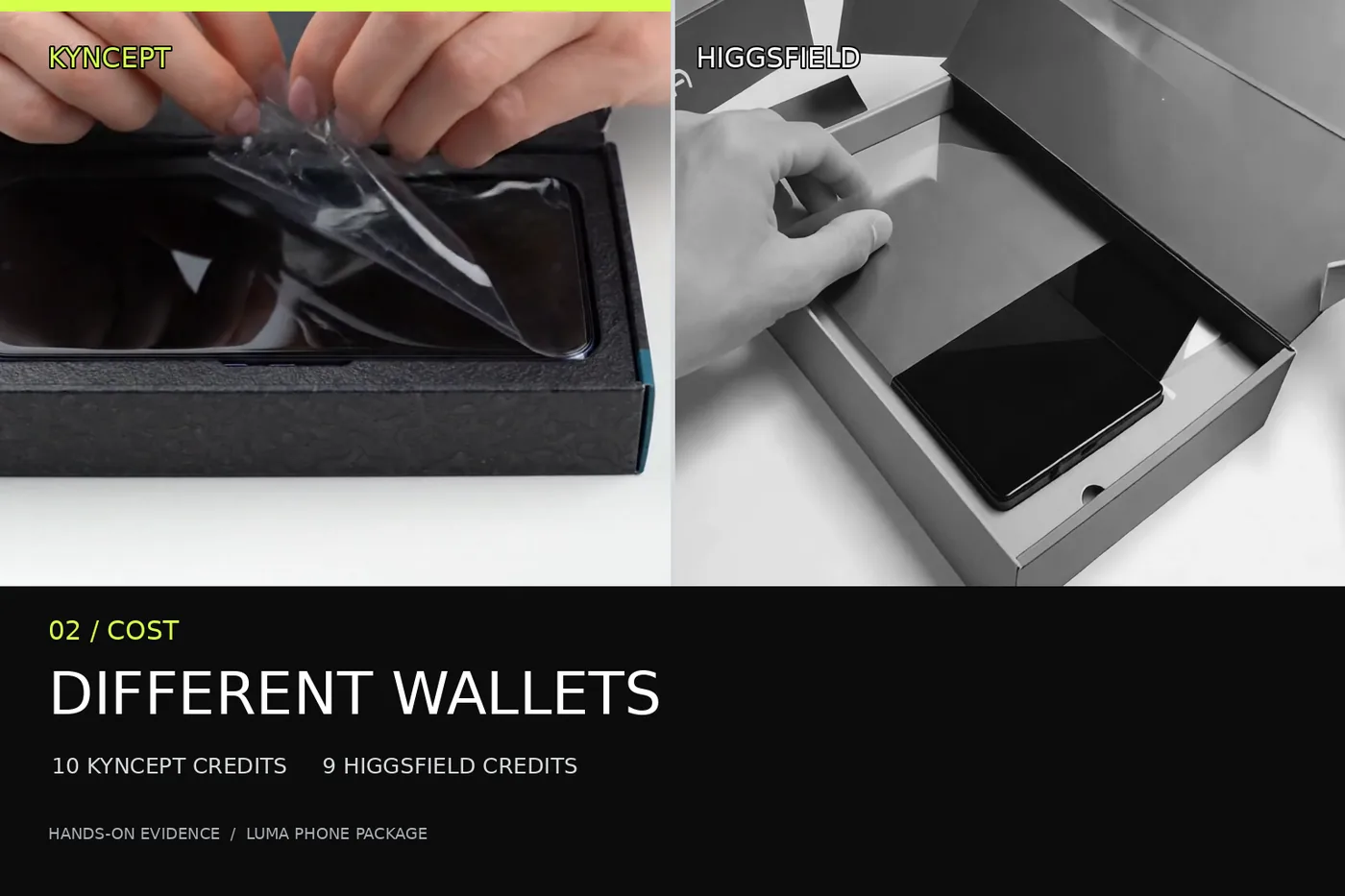
A nine-credit Generate button shows a debit, not a dollar price. It does not reveal the plan that supplied those credits, their renewal terms, or their value relative to another site's ten-credit button. I tested the distinction with a LUMA phone-package image and tabletop unboxing video.
This is an independent hands-on comparison of two third-party tools; both were run on my own accounts — a free tier and a paid plan — with no vendor-provided access. Higgsfield successfully delivered a playable video and two stills in this test. The balances below are observed transactions, not an invented price list.
My verdict in 60 seconds
Higgsfield's tested Wan 2.5 Fast video took 9 Higgsfield credits, from 10 → 1. Two Kyncept Plus videos took 10 Kyncept credits each, from 289 → 279 → 269. Higgsfield's separate image account spent 2 Higgsfield credits per Nano Banana Pro still, from 6 → 4 → 2. Kyncept spent 1 Kyncept credit per Nano Banana Pro still, continuing from 269 → 268 → 267. The units are platform-specific; neither figure is a dollar comparison.
- Video deliverable: Higgsfield selected 5 seconds and delivered 5.042 seconds; Kyncept delivered two 8.000-second files. The prompt requested eight seconds, but the settings were not matched.
- Image observation: the two Higgsfield completion cards appeared earlier than their paired Kyncept UI results. Two runs cannot establish a general speed lead.
- Unpriced: current matching subscription costs, credit inclusions, top-ups, rights, and failed-job treatment were not established.
For a single-file, eight-second first draft, I would try Kyncept here. For a five-second teaser, Higgsfield demonstrably produced one. Neither recommendation rests on an unverified dollar-per-credit conversion.
The comparison the prompt allows—and the one it does not
Both products received text-only LUMA prompts, without reference images or video start/end frames. The still called for a matte-black phone inside a charcoal-and-teal cardboard box with a window and pull tab; the video called for hands to open it, peel film, and lift the phone. Both UIs selected 16:9. But Higgsfield's Wan 2.5 Fast UI selected 5s/720p, although the video prompt said eight seconds. Kyncept's Kyncept Plus results are eight seconds. These are not matched-duration or matched-model video purchases.
For images, both UIs displayed Nano Banana Pro and selected 16:9; all four originals measure 1376 × 768. The common image model makes the debit observation easier to interpret, but it does not turn two proprietary credit units into common currency.
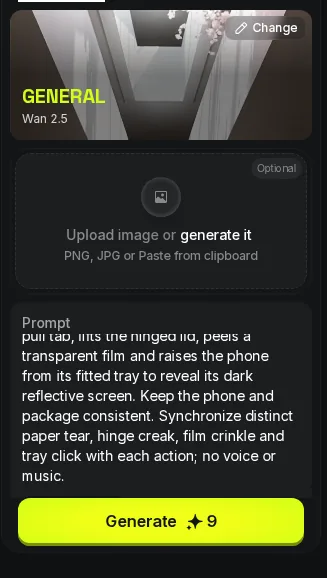
Higgsfield's Wan 2.5 video panel shows Generate marked 9; the completed card below documents the selected 5s setting.
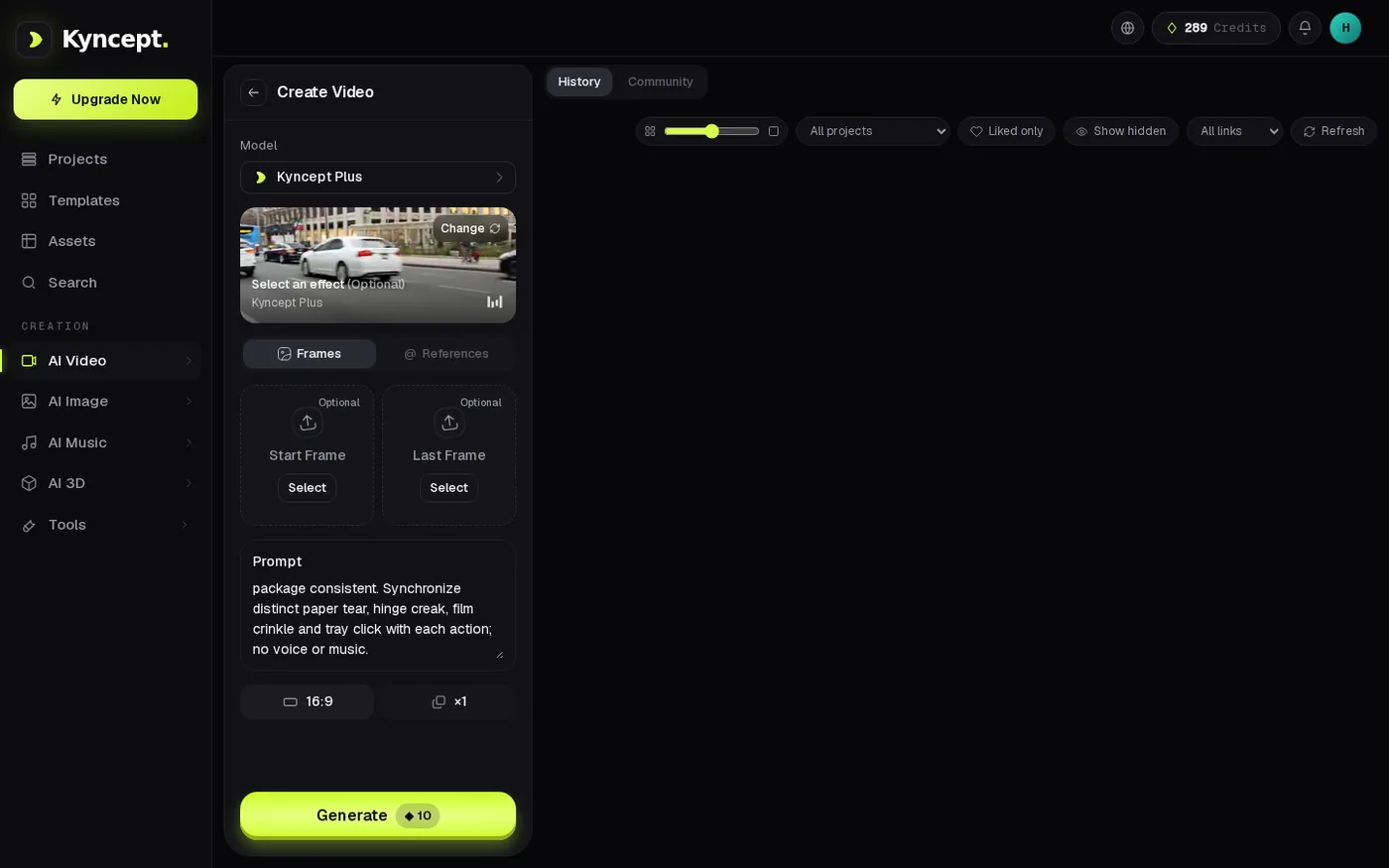
Kyncept Plus shows 16:9 and Generate marked 10; the eight-second runtime was measured from the downloaded files.
Higgsfield's video: a successful nine-unit transaction
The video account showed 10 Higgsfield credits immediately before submission and 1 after delivery: 10 − 1 = 9. The completed History card shows the playable LUMA result labeled Wan 2.5 Fast, 5.0s, 720p, 16:9. The downloaded original measures 5.042 seconds, 1904 × 1104, and 7,937,554 bytes. The 720p UI selection and measured file dimensions are different observations, not interchangeable specifications.
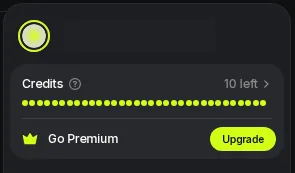
Before this Higgsfield video job: 10 credits left.
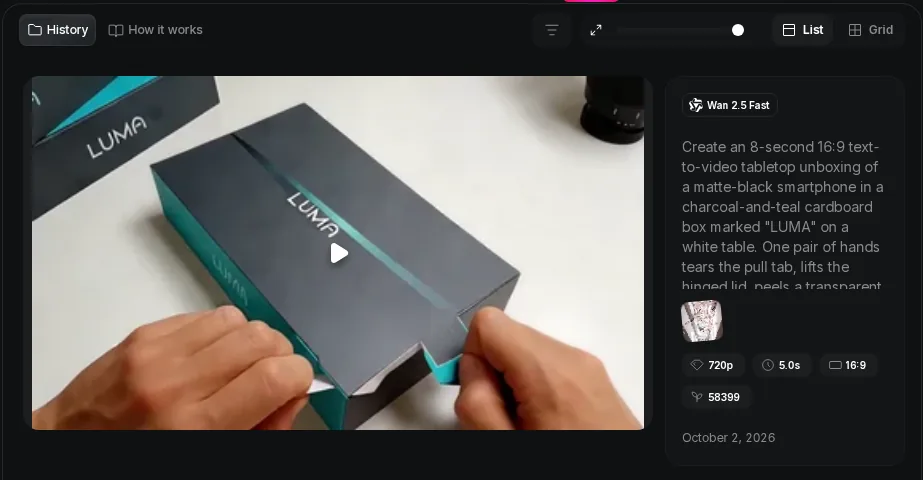
The playable result card lists Wan 2.5 Fast and the UI's 5.0s/720p/16:9 labels.
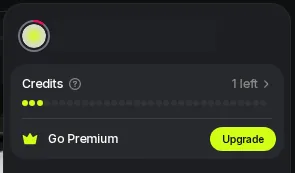
After delivery: 1 credit left in the video account, a nine-credit debit.
This is a successful generation, not a failed attempt. The exact Higgsfield UI completion time is unknown: after-click timestamp logging crashed, and the captured raw response was truncated before its full terminal-status JSON could be parsed. Delivery is established by the playable UI result, matching individual job ID, and downloaded file. The incomplete timing record must not become a made-up speed claim.
Kyncept's videos: two debits in one wallet
The first Kyncept job moved the wallet 289 → 279, the second 279 → 269. Each cost 10 Kyncept credits and produced a distinct 8.000-second, 1280 × 720, 24fps H.264 file with an AAC stereo track. The first original is 2,148,345 bytes, the second 1,951,133 bytes. Different frames show two actual takes, not an expected number of acceptable takes in future batches.
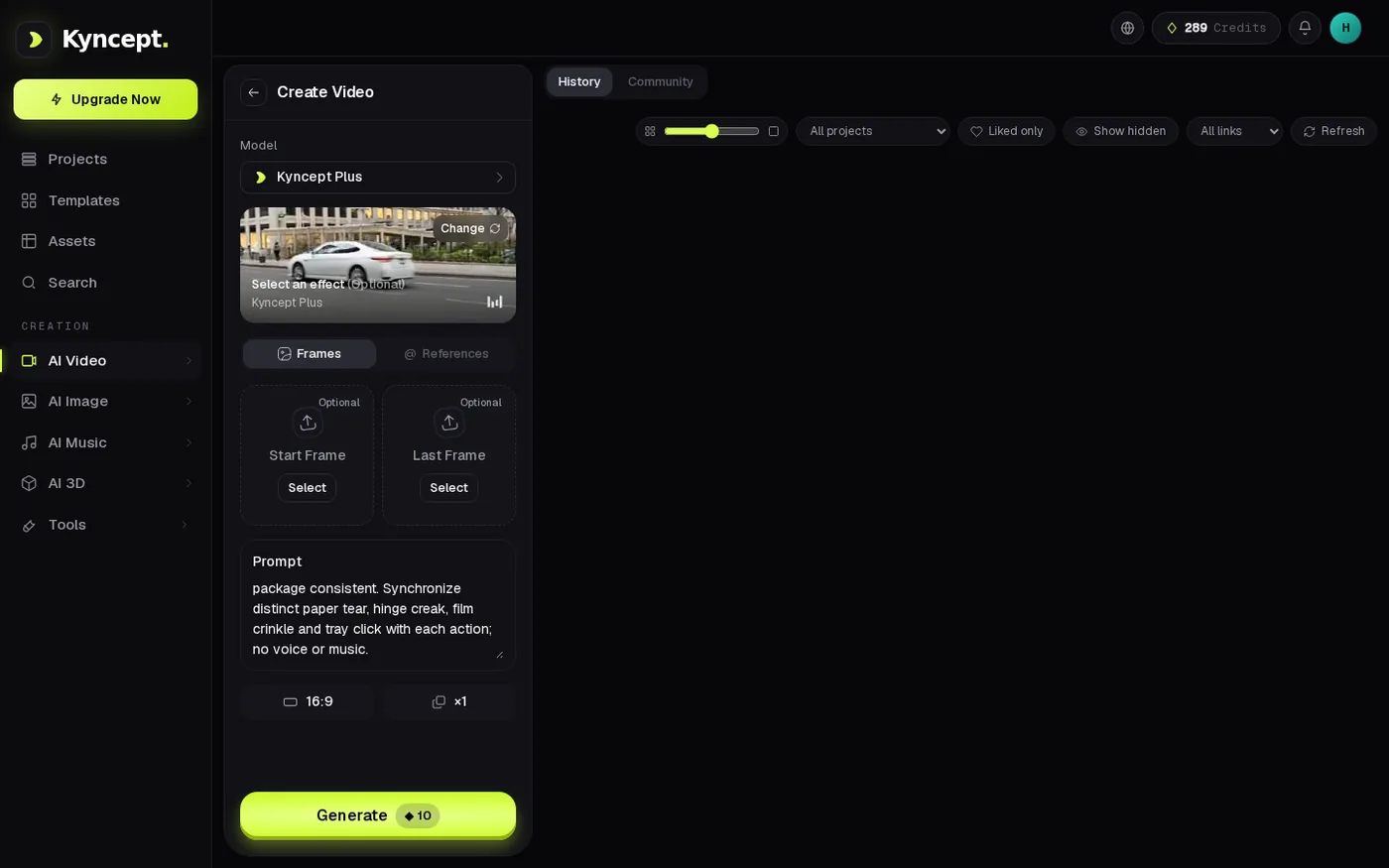
The first Kyncept submission shows 289 in the wallet and 10 on Generate.
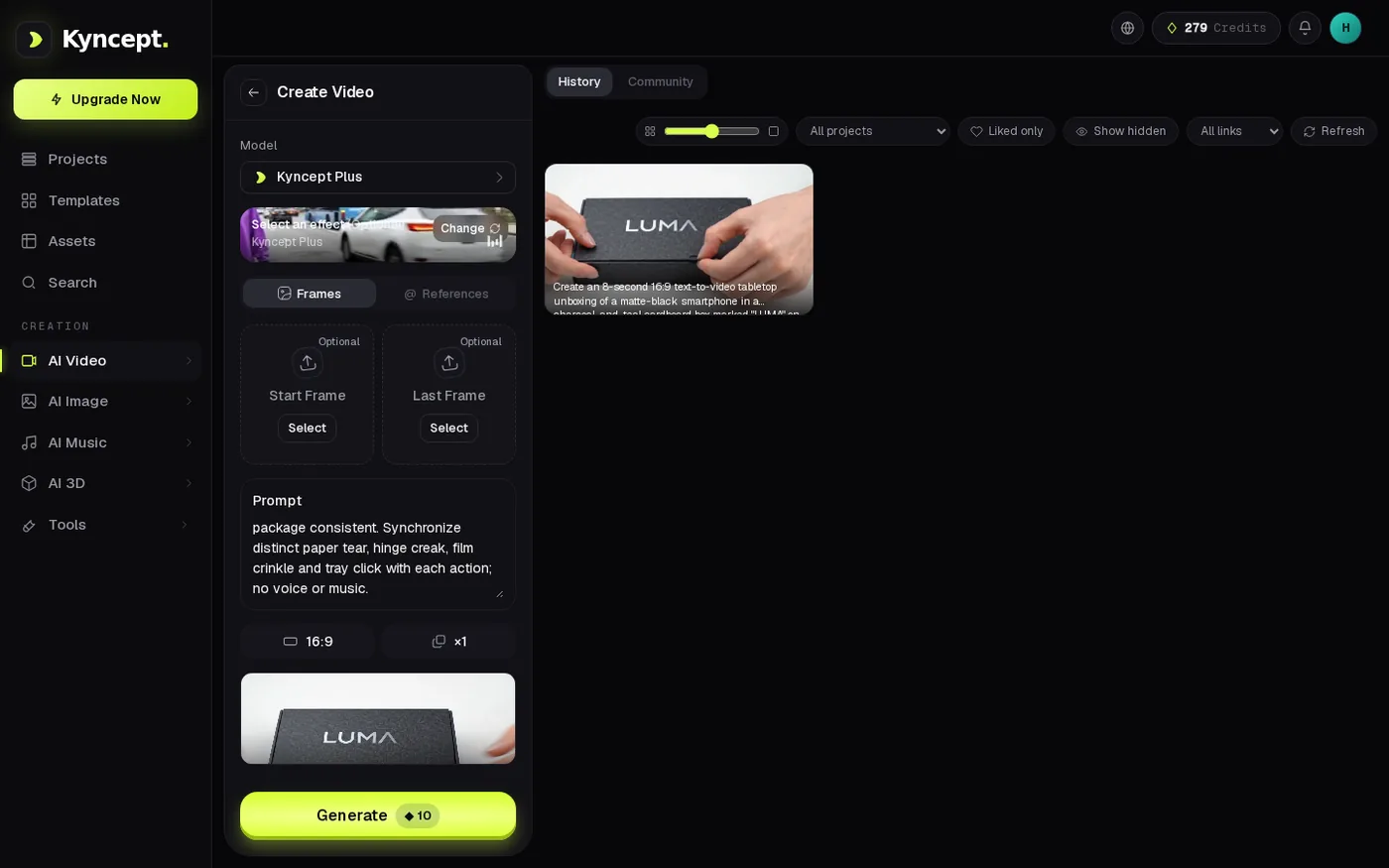
After the first result, the wallet reads 279: ten Kyncept credits spent.
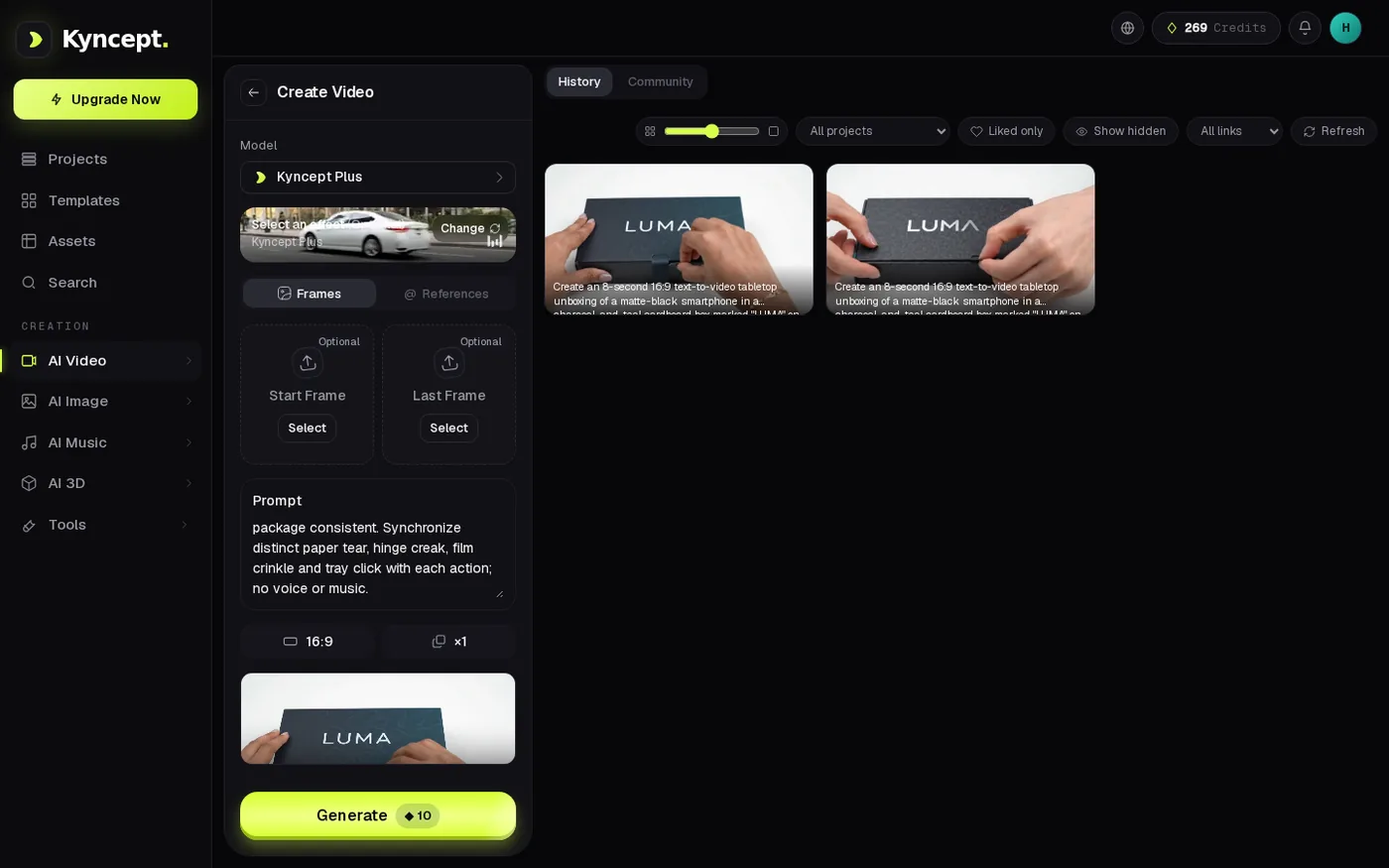
After the second job, two result cards are visible and the wallet reads 269: another ten-unit debit.
The measured Kyncept UI completion times were 91.4 and 282.1 seconds, a 190.7-second spread within two attempts. The test does not establish a typical wait, and the missing Higgsfield video UI timestamp prevents a video-speed ranking.
Why nine versus ten does not settle a video budget
Higgsfield's delivered file is 8.000 − 5.042 = 2.958 seconds short of the prompt's requested runtime under the tested Wan setting. A five-second teaser may be fine; an eight-second storyboard may not be. Kyncept's two observed files meet eight seconds, but a credit count from one platform still cannot be divided by credits from the other. Even a per-second credit figure would have different denominators: different outputs and different proprietary wallets.
An eight-second-capable Higgsfield option might change the decision; its price and output were not tested. Neither other free video models nor a paid Veo generation were tested in this phone case. I will not price an unperformed extension or assert that five seconds is a universal Higgsfield ceiling.
The image buttons are not dollar labels
Both image panels offered Nano Banana Pro with a single 16:9 output selected. Higgsfield's Generate button read 2; Kyncept's read 1. That is a quoted debit in each product's own unit. Even with the same public model name and 1376 × 768 originals, it is wrong to call Higgsfield “twice the cash price.” Subscription allocations, top-up pricing, expiration, and the cost of other plan features remain unverified.

Higgsfield image settings show Nano Banana Pro, 16:9, one output, and Generate marked 2.
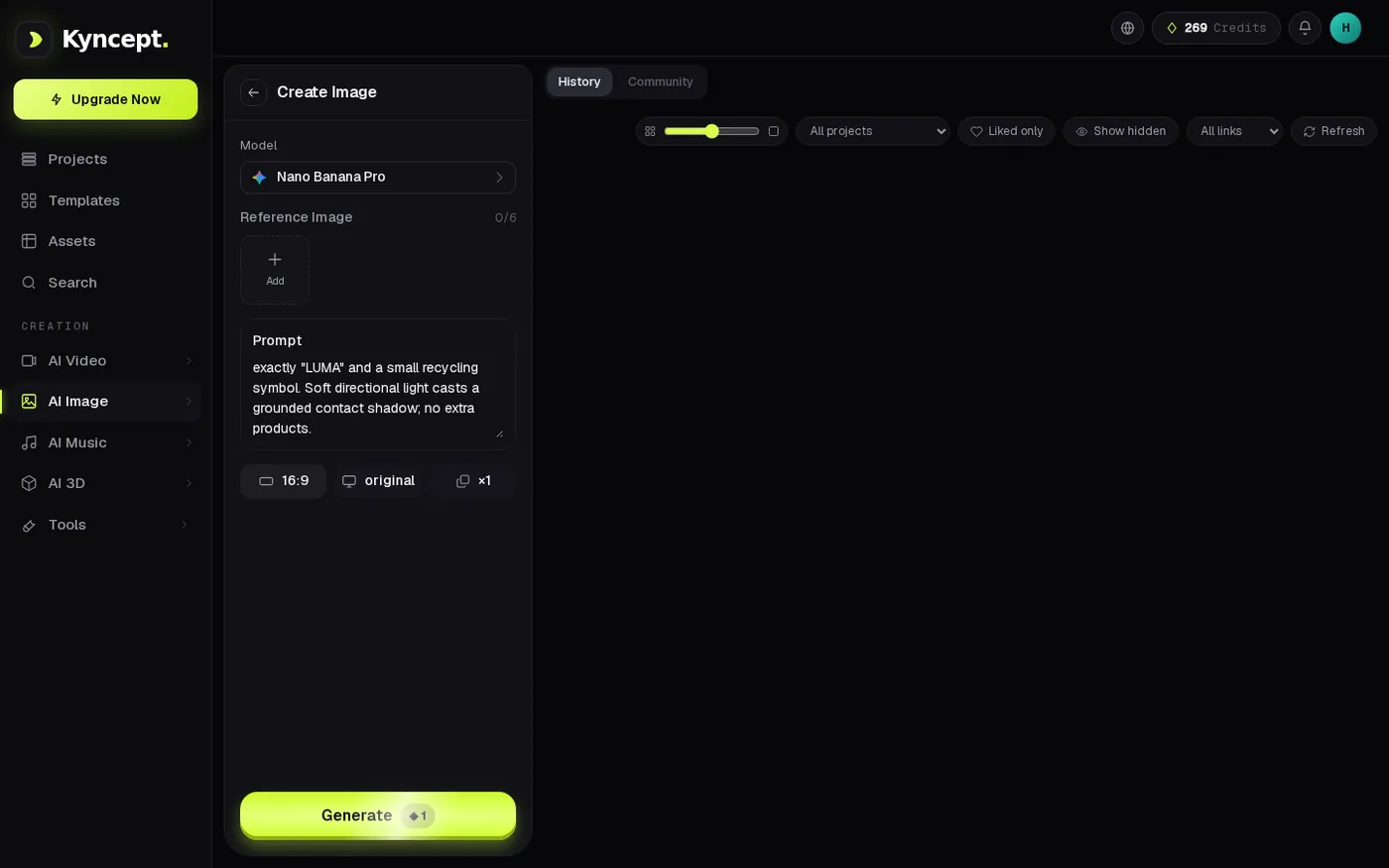
Kyncept image settings show Nano Banana Pro, 16:9, and Generate marked 1.
Higgsfield's separate image account: six to two
The Higgsfield images were made on a different account from the Higgsfield video. This image wallet went 6 → 4 → 2 across two completed stills: two 2-Higgsfield-credit debits, or 4 units in that image wallet. Do not add that account's wallet balances to the video's 10-to-1 sequence or present their combined changes as one account's bill.
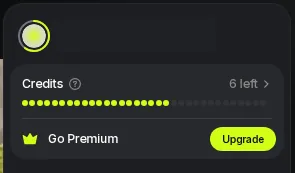
The separate Higgsfield image account begins with 6 credits left.
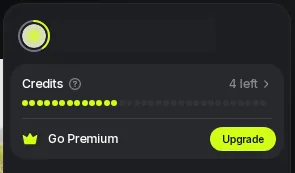
After the first image, that same wallet reads 4: two units spent.
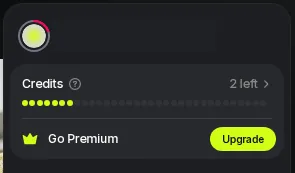
After the second image, that image wallet reads 2: another two units spent.
The first image's completed UI card was observed no later than 41.01 seconds after submission and the second no later than 37.63 seconds. These are completion-card observation bounds, not exact server times. In both paired attempts, the Higgsfield cards appeared before Kyncept's UI results; that favorable observation is limited to this small sample.
Kyncept's continuing image wallet: 269 to 267
Kyncept used one continuous wallet for its two videos and two images. After the videos left 269, the image balances went 269 → 268 → 267: 1 Kyncept credit per still. The UI completion times were 55.7 and 54.0 seconds. They are measured UI times, whereas Higgsfield's figures mark first observed completion cards, so a precise percentage speed advantage would overstate the timing evidence.
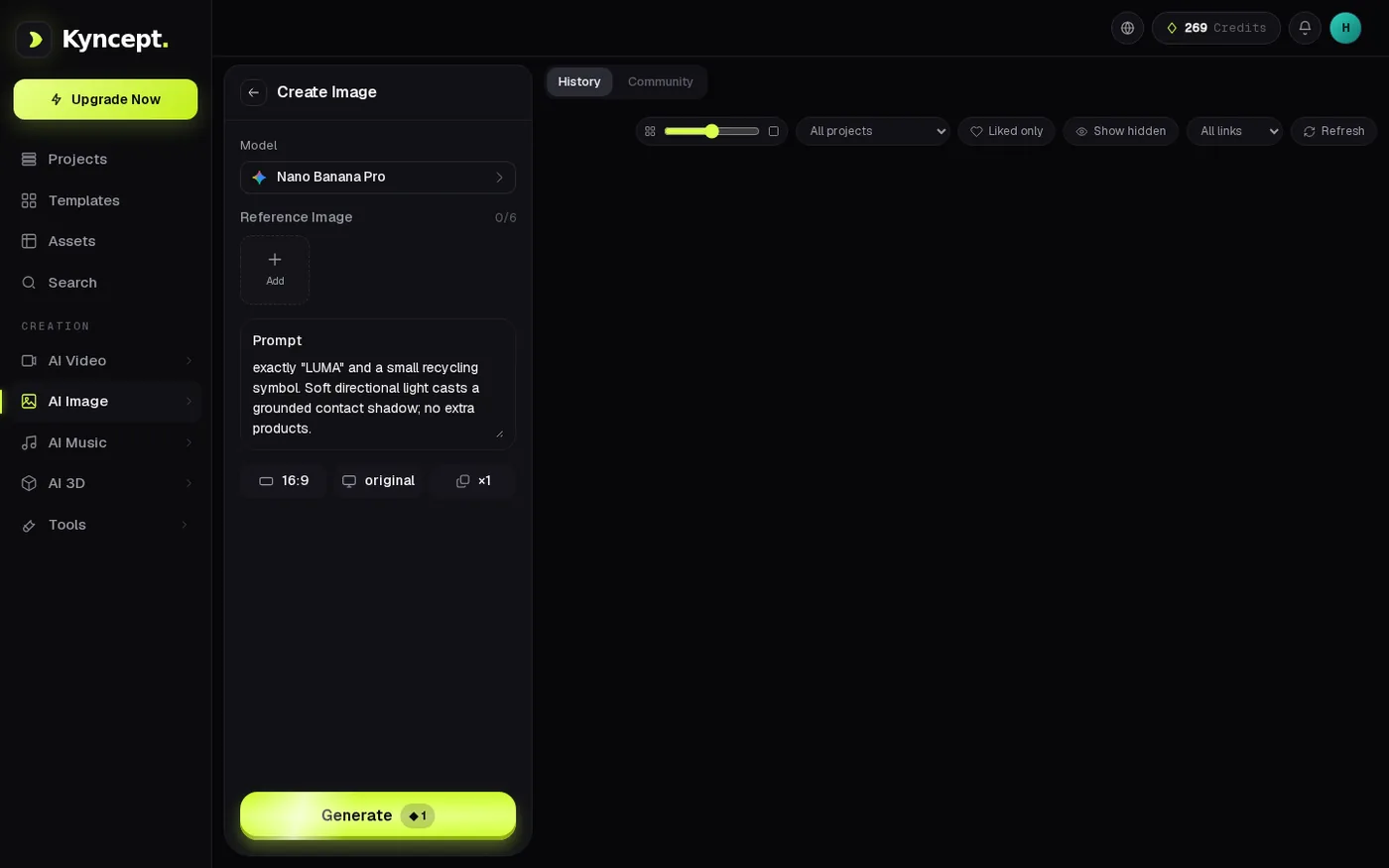
Before Kyncept image one: 269 credits in the wallet and 1 on Generate.
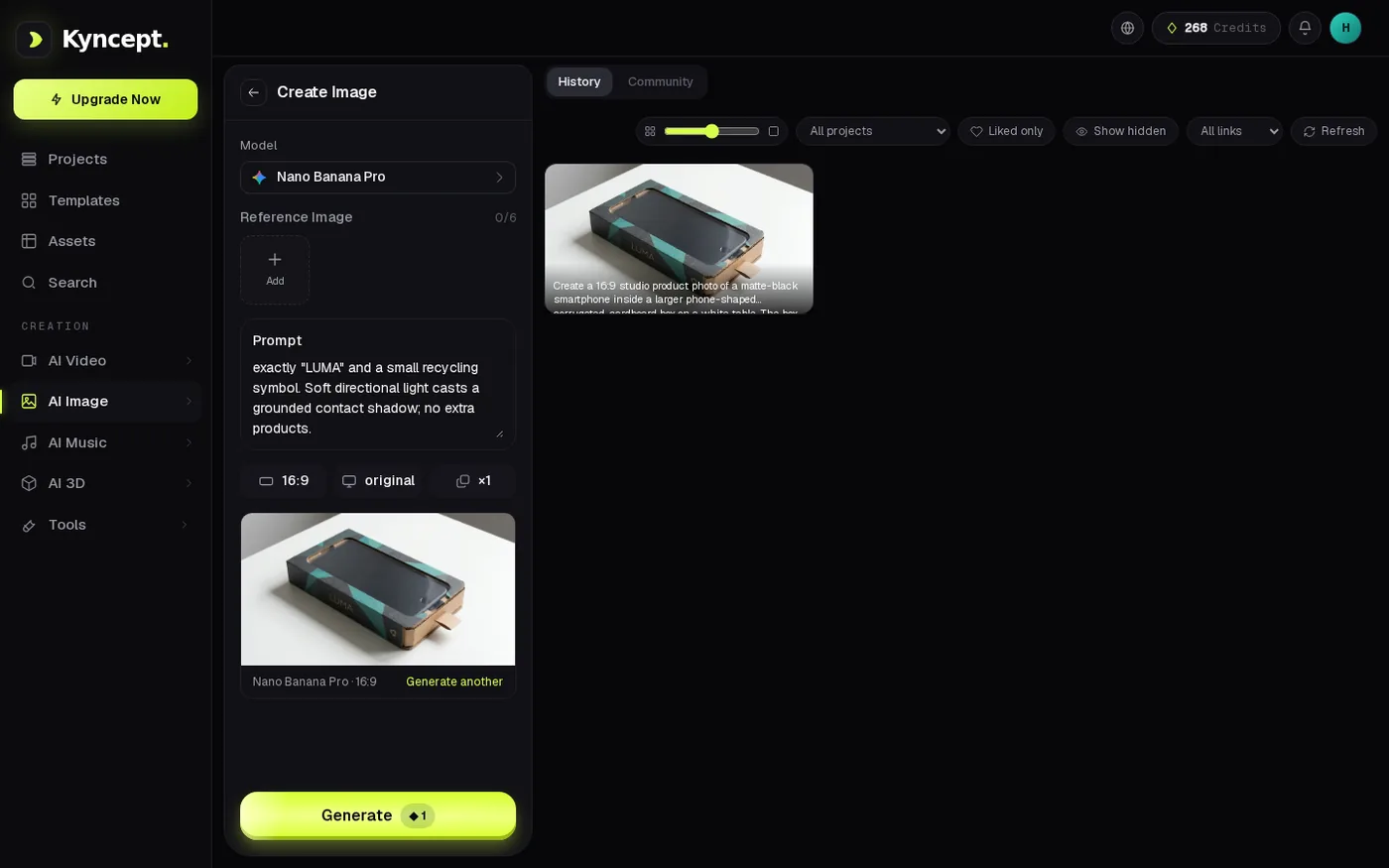
The first completed image appears with 268 credits remaining.
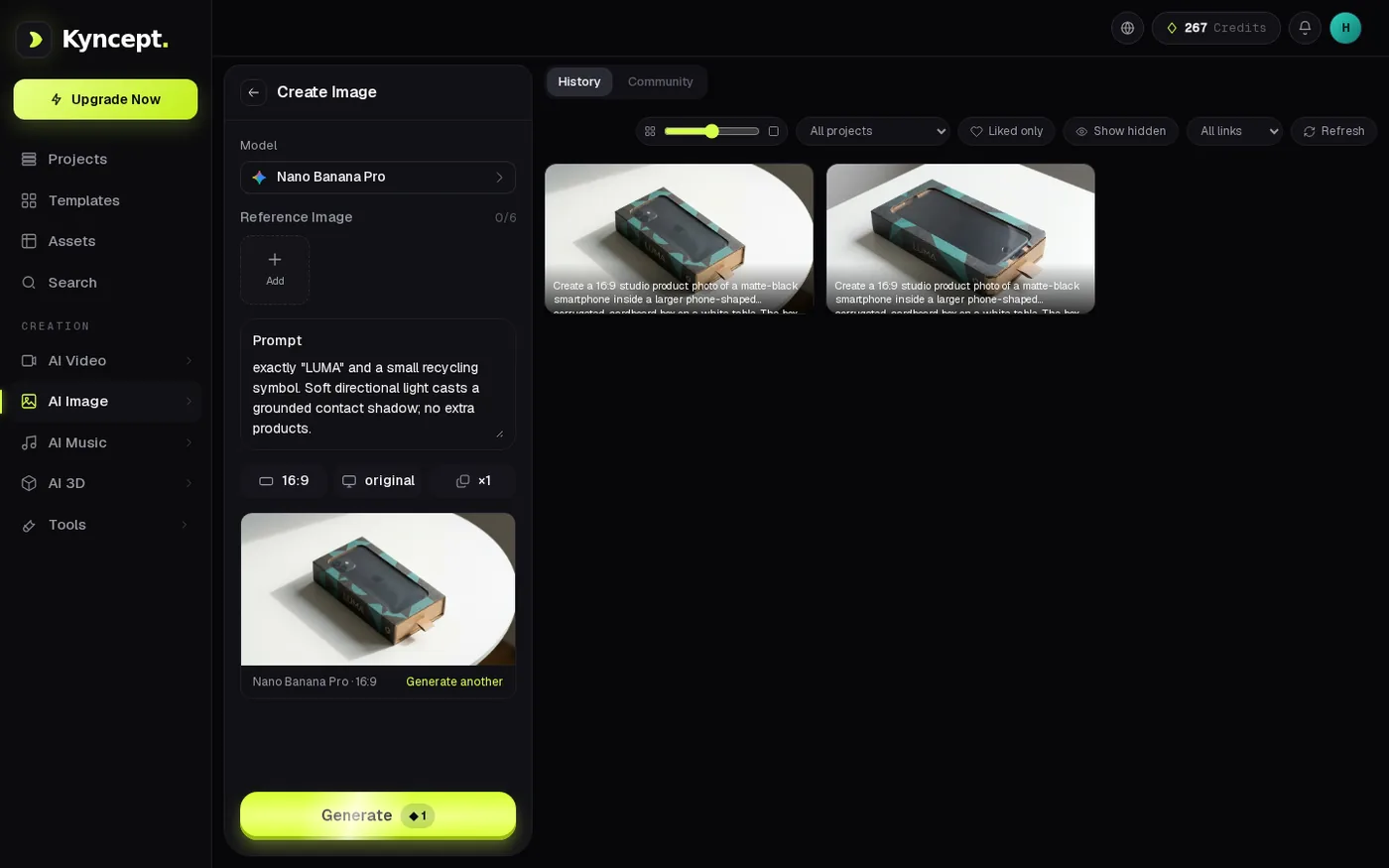
The second completed image appears with 267 credits remaining.
Across the four jobs, 289 − 267 = 22 Kyncept credits: 10 + 10 for video and 1 + 1 for images. That is a legitimate within-wallet total, not a cross-platform cash rate. Both services also produced an unrequested Apple mark in a second image. The detailed image-quality and watermark inspection belongs in the image-focused companion article, not this billing review.
Use case: twenty product stills
For 20 one-image jobs at the observed Nano Banana Pro settings, assuming unchanged debit rates, the planning ledger is 20 × 1 = 20 Kyncept credits or 20 × 2 = 40 Higgsfield credits. The units remain different. Forty is not twice the cash price of twenty. The test accounts' displayed balances do not themselves fund that hypothetical batch, and no matched plan prices were collected.
The earlier-observed Higgsfield cards matter if turnaround is your constraint. A buyer should test that behavior under their own workload, then obtain each plan's included units and renewal terms before turning either projected debit into money. A 20-image spreadsheet is useful as an internal wallet forecast; it is not an invoice.
Use case: two eight-second unboxing takes
The observed Kyncept pair gives a narrow arithmetic result: 2 delivered eight-second takes × 10 = 20 Kyncept credits, with UI waits of 91.4 and 282.1 seconds. The Higgsfield record gives 1 delivered 5.042-second Wan take for 9 Higgsfield credits. Two jobs at that same displayed setting would hypothetically debit 2 × 9 = 18 Higgsfield credits if unchanged; no second job was tested, and that still would not establish two eight-second files. Presenting 18 versus 20 as equivalent output would be wrong even before the currency problem.
Both downloaded videos contain AAC stereo tracks. I did not listen for the requested paper tear, hinge creak, film crinkle, and tray click, nor verify that voice or music is absent. Sound-track presence cannot be priced as verified Foley or used to invent a revision rate.
The checkout worksheet this review cannot complete
There was no freshly verified, matched pair of cash-priced plans in this evidence set. Before converting these receipts into dollars, record these items for both products on the same date:
- Plan terms: actual checkout price, billing period, renewal price, and applicable taxes.
- Credit supply: included units, rollover, expiration, and differences between trial, promotional, and paid credits.
- Comparable job: exact model, duration, resolution, aspect ratio, output count, and pre-submit debit; quote an eight-second-capable Higgsfield option separately if needed.
- Extra usage: top-up price and quantity, plus what happens when included credits run out.
- Usable-output criterion: acceptable duration, sound check, revisions, and a measured keep rate from more than two attempts.
- Terms to verify: current commercial-use permission, failed-job credit treatment, cancellation, and refund rules.
Then calculate cash per usable, specification-matched asset, distinguishing included credits from marginal top-ups. A plan's nominal dollars-per-credit can be misleading when unused credits expire or the subscription includes unrelated features. Nothing in the balance screenshots settles those assumptions.
What the receipts cannot establish
This one successful Wan job does not price all Higgsfield video models or define a free-tier quota. The two image jobs belong to a separate Higgsfield account; the four Kyncept jobs share one wallet but do not establish every customer's allocation. There was no failed-job observation, commercial-license audit, matched checkout, or production month. Therefore there is no evidentiary basis here for refunds, commercial rights, a monthly dollar ROI, or a cross-platform dollar winner.
Nor should file bytes quietly become a price proxy. Higgsfield's tested clip is 7,937,554 bytes versus 2,148,345 bytes for Kyncept's first, but duration and dimensions differ. The stills were Higgsfield PNG and Kyncept JPEG, with different compression. Neither byte ratio ranks sharpness, cash value, or credit purchasing power.
Final verdict: a debit is not an exchange rate
The repeatable findings are 9 Higgsfield credits for a delivered 5.042-second Wan clip, 10 Kyncept credits each for two 8.000-second Kyncept Plus clips, 2 Higgsfield credits each for two Nano Banana Pro stills, and 1 Kyncept credit each for two same-named-model stills. Higgsfield's two image completion cards appeared earlier. These are strong transaction observations and weak dollar-price evidence.
For a five-second teaser, the Higgsfield result deserves consideration. For an eight-second single-file brief, the observed Kyncept result meets the duration while the tested Wan setting does not. Verify a matching Higgsfield alternative and both live plans before buying. Nine credits are not nine dollars, and they are not inherently cheaper than ten credits on another platform.
Which one I would use for this job
For two alternative eight-second LUMA takes, I would start with Kyncept because this run delivered both files and recorded a continuous 20-Kyncept-credit video debit. I would still trial Higgsfield for time-sensitive stills, because its cards appeared earlier in both paired image attempts. That is my disclosed workflow preference, not a claim of a lower cash bill. Check the live settings at https://kyncept.com before spending on either service.
Originally published on Medium: Higgsfield Pricing Review 2026: Nine Credits Are Not Nine Dollars.